
Creating a hit song is never easy, but crafting a Christmas hit may be even more difficult. Not only are you competing with other contemporary artists, but you’re also going head-to-head with classic religious and cultural carols that have had hundreds of years’ head starts to build their popularity.
Despite this, many musicians take a swing at crafting memorable holiday music. And while the majority of efforts fall by the wayside, those that do catch on inevitably crop up year after year, delivering festive cheer in the process.
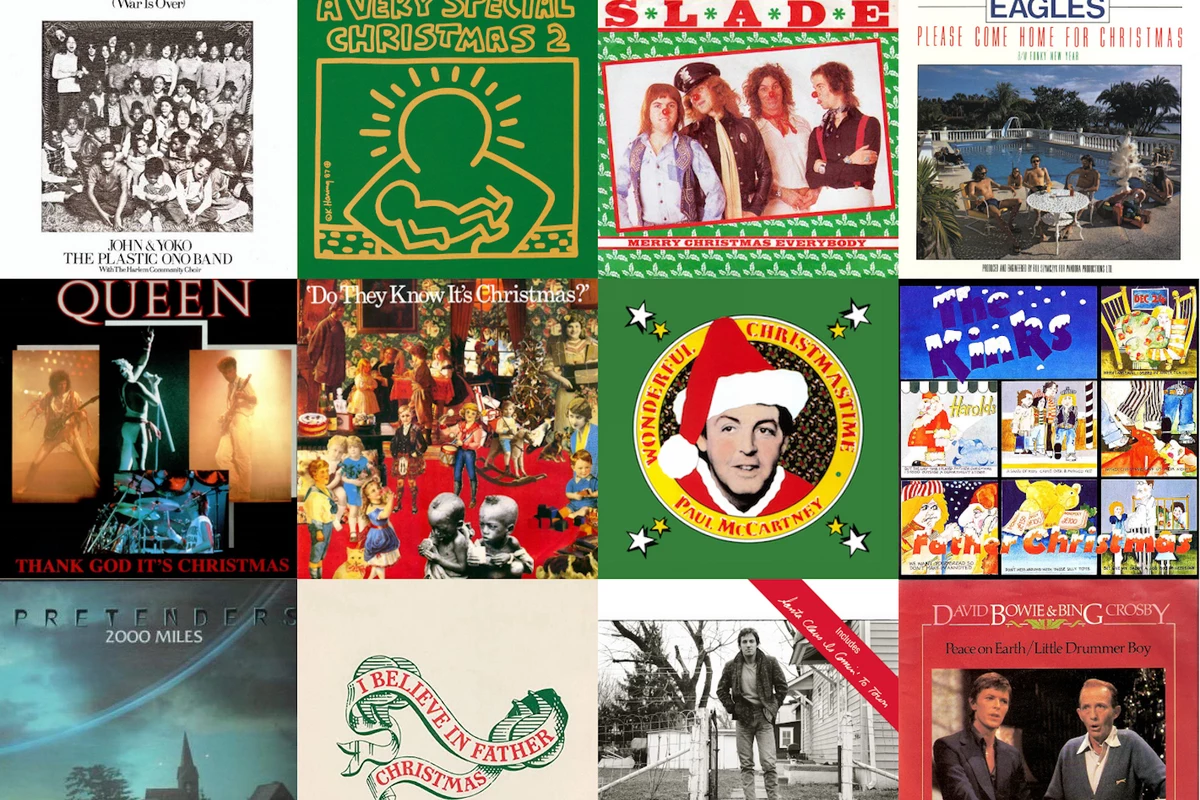
The origins of the below holiday classics are as varied as the artists who deliver them. In some cases, inspiration came from a friend or family member; in others, a charitable cause helped get the creative juices flowing. Here are the stories behind 15 of classic rock’s most-loved Christmas songs.
Slade, “Merry Christmas Everybody” (1973)
At the suggestion of his mother-in-law, Slade bassist and songwriter Jimmy Lea decided to try his hand at a Christmas tune. Lea took some ideas to the band’s singer, Noddy Holder, who combined them with an unused concept created several years earlier. Lyrically, Holder wanted to “reflect a British family Christmas.” “Economically, the country was up the creek. The miners had been on strike, along with the gravediggers, the bakers and almost everybody else. I think people wanted something to cheer them up — and so did I. That’s why I came up with the line ‘Look to the future now / It’s only just begun,'” Holder explained to the Daily Mail in 2007. The result was “Merry Christmas Everybody,” a massively successful single that quickly sold millions of copies and remains popular to this day.
Read More: The Story of Slade’s Festive Glam Smash ‘Merry Xmas Everybody’
The Kinks, “Father Christmas” (1977)
The mugging of a department-store Santa highlights this unlikely Christmas hit by the Kinks. Penned by Ray Davies, the track was a thinly veiled commentary on class warfare, as jolly Saint Nick represented the rich elite, while his robbers were the poor working class. Even though it’s since become a holiday classic, reviews of “Father Christmas” were mixed upon its release – some critics loved the catchy riffs, others found the lyrics decidedly “anti-Christmas.”
Read More: When the Kinks Got Deceptively Festive on ‘Father Christmas’
John Lennon, “Happy X-Mas (War Is Over)” (1971)
Part Christmas song, part protest against the Vietnam War, “Happy Xmas (War Is Over)” reached No. 4 in the U.K. in 1971. The track reflected John Lennon and Yoko Ono’s peace campaign, which eventually spanned more than two years. The phrase “War is over, if you want it” was used on publicity material supporting the couple’s cause before becoming a famous refrain in the song. With its heartfelt theme and sing-along chorus, the cut became one of Lennon’s most popular solo releases. It has been covered by a range of artists since its release, including John Legend, Miley Cyrus, Neil Diamond, REO Speedwagon and Diana Ross.
Paul McCartney, “Wonderful Christmastime” (1979)
Not to be outdone, Lennon’s former Beatle bandmate Paul McCartney released his own holiday song in 1979. Recorded during the sessions for his solo album McCartney II, “Wonderful Christmastime” became a global hit, charting in 19 different countries. Despite this success, the song was quite polarizing. Critics scrutinized the simplistic lyrics and keyboard-heavy arrangement, calling it one of McCartney’s weakest releases. Still, we like to see this cup of eggnog half-full. For all its faults, “Wonderful Christmastime” has managed to become a holiday mainstay, spreading festive cheer on a yearly basis.
David Bowie and Bing Crosby, “Peace on Earth/Little Drummer Boy” (1977)
In one of the most unlikely holiday duets of all time, David Bowie and Bing Crosby joined together in 1977 “Peace on Earth/Little Drummer Boy.” The track, filmed as part of Crosby’s Merrie Olde Christmas TV special, almost didn’t come together. Bowie wasn’t thrilled that he was being asked to sing “Little Drummer Boy” and reportedly requested the tune be altered. Meanwhile, producers were shocked when Bowie arrived in makeup and earrings – a far cry from Crosby’s buttoned-down, conservative ways. Still, compromises were made and the icons of two generations ended up sitting together at the piano for a charming – if awkward – performance. It remains a holiday pop-culture landmark moment.
Read More: When David Bowie and Bing Crosby Rang in the Holidays
Greg Lake, “I Believe in Father Christmas” (1975)
Greg Lake had a guitar riff that refused to get out of his head. Making matters worse, he couldn’t find the right way to mix it into a song. Frustrated, the rocker found himself humming the tune to “Jingle Bells” over the riff. It surprisingly worked, but it wouldn’t be until writing partner Peter Sinfield encouraged Lake to go further down this path that “I Believe in Father Christmas” took shape. Inspired by the childhood innocence of the holiday – and pushing against its commercialization – the song became an unexpected hit in 1975, peaking at No. 2 on the U.K. chart.
Read More: How Greg Lake Stumbled Into His Famous Yuletide Song ‘I Believe in Father Christmas’
Band Aid, “Do They Know It’s Christmas?” (1984)
After seeing footage of the famine-ravaged Ethiopia, Boomtown Rats frontman Bob Geldof was inspired to create a charity holiday single. He enlisted Ultravox’s Midge Ure to craft the song, creating the synth-pop basis for what would become “Do They Know It’s Christmas?” Many of era’s biggest musical acts were involved in the project, including Paul McCartney, Sting, David Bowie, Bono, Phil Collins and members of Duran Duran. A grueling 24-hour recording session would give the song life, with each artist recording various parts. The track became an immediate hit upon release, selling more than a million copies and eventually becoming the biggest-selling single of all time in the U.K. (a title it would lose in 1997 to Elton John’s “Candle in the Wind 1997”). The single earned approximately $10 million for Ethiopian famine relief in its first year of release.
Read More: The Story of Band Aid’s ‘Do They Know It’s Christmas?”
Queen, “Thank God It’s Christmas” (1984)
In 1984, Queen released their enduring holiday single “Thank God It’s Christmas.” The original composition was created by drummer Roger Taylor, with guitarist Brian May contributing the chorus. Once the song was rounding into form, the two approached singer Freddie Mercury. “When it was almost finished, we presented it to Freddie, who loved it and did a beautiful vocal,” May recalled in a 2018 interview on the Ultimate Classic Rock Nights radio show. “I think it’s just the most understated vocal, and I love it.” The track peaked at No. 21 on the U.K. chart and was later included on Queen’s Greatest Hits III, released in 1999.
Read More: Brian May Praises Freddie Mercury’s ‘Beautiful’ and ‘Understated’ Vocal on Queen’s Christmas Song
The Pretenders, “2000 Miles” (1983)
Although many listeners believe “2000 Miles” is about long-distance romance during the holiday season, the song was actually inspired by tragedy. In June 1982, James Honeyman-Scott, guitarist and founding member of the Pretenders, was found dead in his girlfriend’s apartment. The band’s frontwoman, Chrissie Hynde, penned “2000 Miles” while thinking about her departed bandmate. The tender track struck a chord with listeners, becoming a seasonal hit upon release in December 1983.
Bruce Springsteen, “Santa Claus Is Comin’ to Town” (1982)
Bruce Springsteen and the E Street Band initially began mixing a cover of the holiday classic “Santa Claus Is Comin’ to Town” into their sets in 1973. It wouldn’t be until 1975 that they recorded the track during a performance at C.W. Post College in Greenvale, N.Y. Even then, the song would sit on the shelf for several years – later getting released on the Sesame Street compilation album In Harmony 2 (1982). Despite receiving little promotion, Springsteen’s rendition has arguably become the premier version of “Santa Claus Is Comin’ to Town.” His joyous delivery, coupled with a lively sax solo by Clarence Clemons, helped make the song a holiday staple for generations of fans.
Eagles, “Please Come Home for Christmas” (1978)
Eagles were in the midst of sessions for their overdue sixth album, The Long Run, and their record label was getting impatient. The band was behind schedule and, given the success of their previous album, Hotel California, executives wanted new material to release. In an effort to satiate their bosses, Eagles decided to record a Christmas song. Don Henley suggested “Please Come Home for Christmas,” a song originally recorded by blues singer Charles Brown in 1960. The band’s version of the track did the trick: Not only did the record label get off the band’s back, but the single became a holiday hit.
Read More: How ‘Please Come Home For Christmas’ Emerged From Eagles Time-Out
Tom Petty, “Christmas All Over Again” (1987)
Beginning in 1987, acclaimed producer Jimmy Iovine started releasing albums under the title A Very Special Christmas, with proceeds benefiting the Special Olympics. For the second edition, Tom Petty contributed an original track that would go on to become a celebrated holiday favorite. “Christmas All Over Again” layered chimes, bells, horns, percussion and harmonies over Petty’s rock croon, delivering an upbeat Yuletide jam.
Dee Snider and Celine Dion, “The Magic of Christmas Day (God Bless Us Everyone)” (1998)
Would pop singer Celine Dion really record a holiday tune written by Dee Snider? The Twisted Sister frontman didn’t want to take any chances. “Do not tell her that Satan wrote her Christmas song,” Snider recalled telling producer Ric Wake. “Just put it on the fuckin’ album.” And so – more than four years after Snider originally wrote a Christmas song at the suggestion of his wife – “The Magic of Christmas Day (God Bless Us Everyone)” was released on Dion’s These Are Special Times LP. The album was a massive hit, selling more than 14 million copies worldwide and becoming one of the most successful Christmas albums in history.
Read More: Why Dee Snider Finally Recorded His Big Hit Christmas Song
Elton John, “Step Into Christmas” (1973)
It only took one day – Nov. 11, 1973 – for Elton John to record his classic holiday track “Step Into Christmas.” The song was the legend’s way of saying thank you to fans who had helped make 1973 an especially successful year. “The Christmas single is a real loon about and something we’d like to do a lot more of,” John is quoted as saying in the biography Elton John in His Own Words. Thought of as more of a novelty single than a serious release, the song still managed to achieve mainstream popularity. “Step Into Christmas” hit No. 24 on the U.K. chart at its time of release and has continually popped up each holiday season since.
The Pogues, “Fairytale of New York” (1987)
Where “Fairytale of New York”‘s inspiration came from depends on whom you ask. The Pogues’ accordion player James Fearnley claims the idea to write a Christmas song came from the band’s manager, while late singer Shane MacGowan insisted it stemmed from a bet between himself and Elvis Costello (who produced the Pogues’ 1985 album, Rum, Sodomy & the Lash). “Fairytale of New York” took more than two years to complete. The band’s banjo player, Jem Finer, co-wrote the song and initially penned lyrics about a sailor missing his wife at Christmas. Finer’s own wife said it was corny. “So I said, ‘Okay, you suggest a storyline, and I’ll write another one,” he later recalled to The Irish Times. “The basic plotline came from her: this idea of a couple falling on hard times and coming eventually to some redemption.” MacGowan would come up with his own lyrics, eventually combining them with Finer’s to create the classic track. Then singer-songwriter Kirsty MacColl contributed vocals, essentially making the song a dialogue between the embattled couple. “Fairytale of New York” peaked at No. 2 in the U.K. upon its release and has since been ranked among the greatest Christmas songs in rock history.