
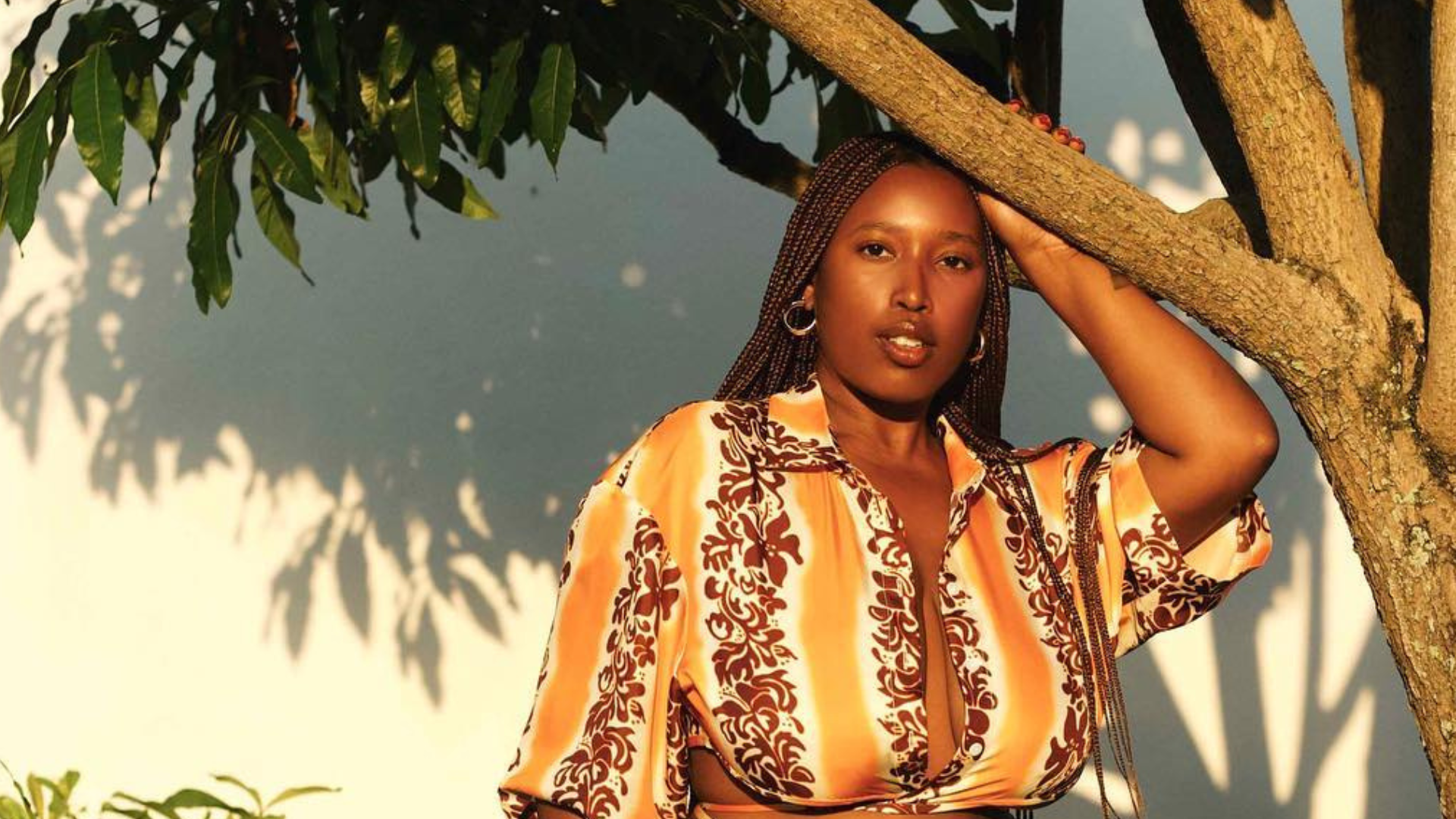
Three years ago fashion maven Mecca James-Williams moved to Jamaica, she says she felt a call to the island. Known for her styling contributions to Solange’s When I Get Home film and various magazine covers and editorials, James-Williams decided to leave New York City after 10 years. Even with the label stylist, she’s been able to stray away from the parameters the fashion industry can limit others in.
Throughout her career, James-Williams has created a distinct signature to her styling work often enriched with color that she can use as a statement or as a constant in a look. She describes styling as a tool to communicate more than just an outfit. Like many artists, she wants to leave an impact. And she’s doing just that with her new e-commerce platform Sweet Like JAM.
Throughout the website, one is immediately met with the warmth the Jamaican sun gives James-Williams. She’s visually telling a story about the culture she’s learned and experienced on the island. Brands such as Nia Thomas, Bande NYC, Emily Watson, and Francesca Lake were featured in her first drop. The process of curation has become second nature for James-Williams as her career moved from budding to established in the city. Brands that create a hearty narrative that encapsulates homage to ancestry and look to the future of legacy are what attract the stylist’s keen eye.
Within Sweet Like JAM, we see brands that turn to innovation rather than the boxes people might have placed them in at one point in their design careers. This is what Sweet Like JAM is all about—finding your way outside boxes and preconceived notions all while forging ahead.
The driving force of the commerce site is not just to shop, but to learn, connect, and experience the richness of the African diaspora. James-Williams is expanding on what that can look like through the retail space in her own way. Commerce becomes democratized within her new online retail space. Rather than relying on other large conglomerates to platform these brands, she’s reminding designers and fashion creatives that they can do it for themselves.
With this new venture as a business owner and founder, James-Williams is transforming the way we view shopping by cultivating a new path for consumers to take. In this ongoing, growing project she’s become a student of life once again, letting go of her own set of ways she’s had in the fashion industry.
In her own words, she’s “flowing with the river” and tapping her inner child with a newfound approach to playfulness in the world of business. According to Mecca, the goal of Sweet Like JAM is to set the precedent for productive and fruitful conversations. It also was created to expand the legacy of entrepreneurship and storytelling from an array of cultural lenses. To accomplish this feat the consultant and stylist plans to highlight creatives and designers throughout the African diaspora to further push her mission: digging into the sweet spot is significant and worth chasing. It’s the “glue that connects me and you,” as James-Williams puts it.
Below Mecca James-Williams tells ESSENCE what to expect from her brainchild, the e-commerce platform Sweet Like JAM, why she’s championing Jamaican-based designers, and breaks down the process behind connecting Jamaica to those throughout the globe.
ESSENCE: For those who are not familiar with your work and your background, what should they know about you?
Mecca James-Williams: That I am a human being first. I am a woman who is very tapped into her spirit, mind, body and soul and any of the work that I touch comes into communication with, I try to leave an impact. A lot of that is through color [and] storytelling. A lot of that is through community building [too], but also through inspiration.
I want any of the brands that I create, any of the stories that I tell to inspire people to be the highest version of themselves and connect with their lineage and connect with people that they find beauty in. On top of that, I’m also a stylist, a fashion editor, a creative director, and a consultant. I’m moving more into being a global culture editor right now. I think that there are stories that we can tell outside of the lens of fashion, and I’m excited to be using things as vehicles and not things as boxes.
You have a special affinity for Black brands and brands by diverse founders, how does this impact your work as a stylist?
I think it’s not even [strictly] Black brands. I think it’s just brands that I see myself in, and that happens to be through artists who can create narratives in a world that I live in. I am attracted to Wales Bonner, I’m attracted to Diotima. I’m attracted to Bode. I’m attracted to House of Aama. I think stories that connect to legacy, lineage, people who came before us, history through a button, in a stitch, in the fabric being used. I like things that can stand the test of time.
I like things that can tell stories through different lenses. I also love color. I’m someone who does not run from color. I’m someone who knows how to use it as a classic and not only as a statement. I think when it comes to brands, I really am attracted to people who can be authentically themselves, and that can be your attraction to something.
Can you break down how your styling background intersects with the creation of an e-commerce platform?
Styling is a vehicle for me. It’s something that I use to move the needle, whether it’s in my life, whether it’s in the creative community that I’m inspired by, or whether it’s in the legacy that I want to leave behind. Styling for me has always been a tool, and when it came to my journey of moving to Jamaica, I knew I wanted to create something outside of my name. I think over the last four years, it’s been beautiful that we’ve all been able to create our own personal brands and put ourselves at the forefront, but I really wanted to strip myself from being in the forefront and create a brand that can inspire people to connect with each other and styling is a huge way for me to be a collaborator. It’s a huge way that I find various brands. I wanted to use fashion as a connecting point of culture and commerce for brands, and that’s what came about with Sweet like JAM.
When did you realize you wanted to create Sweet Like JAM? Was there a moment when you realized the fashion industry needed this?
Sweet Like JAM was a dream that came to me. I had a really beautiful opportunity to collaborate with a few creatives out here [in Jamaica] . We all were like, “Okay, if we wanted to do something, what would we do?” Naturally, everybody’s like, “You should open a store here in Jamaica. You should bring various fashions here.” I love living in Jamaica, but this is the place that I can be private.
Jamaica is one of the places that I’m inspired by, not the only one, so I wanted to create a platform that could be expansive for the global narrative. I just started dreaming and putting the pieces together of what fashion is missing. Fashion is missing connection. We like to talk about this line of connection, but it’s only for the image, not for the actuality of it.
It’s something that I’m still learning how to do as a fashion creative. I think connection is more than just selling a piece. It’s learning from the landscapes you’re in. When I moved to Jamaica three years ago, I didn’t jump to start a brand. I didn’t jump to bring all my clients here and tote the beaches and the beautiful landscape. I went silent. I dived deep into who I was, the climate, the landscape that I’m in, and dive deep into learning a different culture, outside of my own.
You have such a specific lens as a stylist, can you share how this assisted with creating Sweet Like JAM?
To broaden it outside of styling and more toward creative direction, I think I see things through the images that I take and the stories that I put together, but it’s different when I see people resonate with it and see the vision too. People are like, “I saw this brand, and I think they would be perfect for Sweet like JAM.” And they are able to articulate so quickly what would work within the lens that I’ve created.
That shows me that I am painting a picture that people can see. As an artist, you’re not aware of that so much. Especially 10 years ago when I was starting to start styling in a different lens, outside of the world that I lived in. I didn’t know I would be creating what people would call an aesthetic. I didn’t know I would be creating the “Mecca JW lens,” it was just my inside coming out. As a creative director, and as somebody who’s a founder of a very bright, bold, vibrant, sweet, tasty brand, I wanted to invoke all senses. That’s how I live my life. I’m such an Earth woman. I like to taste, feel, see, and touch.
So when it came to JAM being a play-off of jam and it being the glue that connects us, I knew that I wanted to create something that made you think in an abstract way and not in a direct way. Jam is something that binds something together, and it does it in a sweet way, not a hard way. I love alliteration. I love things that come together in a really cool, sweet, groovy way, and not like this is what it needs to be. That’s where JAM came from.
What have you learned over the past few years that has informed you while creating Sweet Like JAM?
As a new business owner, outside of the business that I have for Mecca JW Studios, I’ve learned to not be so dogmatic. I’ve learned not to be so steadfast on the vision. Iterations of ourselves are going to create its own version of what it’s supposed to be, not what we think it’s supposed to be. As a Virgo, I can be very keen and articulate on seeing this vision through and JAM has taught me to flow with the river, flow with the waves, you don’t need to present something in one way. It’s growing and pushing you to do it in a different way.
I really trust the universe, I trust the people that I’m working with, and I trust my mistakes. I’m not failing, I’m failing forward. I’m not losing, I’m learning lessons. Being a business owner in another country, being a Black woman, [and] being someone who’s trying to bring retail and culture to the forefront is not easy. It requires a lot of capital and to start a retail brand by myself with savings has been taxing, but it just showed me how savvy I am, and it showed me how creative I can be, and it showed me that failure is not loss, it’s just growth.
So, I’ve been honored to have brands and people [who] can see the vision and that support it and pour into it when it’s still creating itself. I think that kind of speaks to the communal impact that we are growing into. Everything doesn’t have to be set in stone for you to play. JAM is play. If there’s one thing you could feel from it, I would want people to know you can release the restrictions and play and learn how to play with each other.
When did you move to Jamaica?
I moved to Jamaica in November of 2021 so three years ago, and that’s why I wanted to [launch Sweet Like JAM] in the same month that I moved for it to be on the anniversary of the month that I moved here, because Jamaica expanded me outside of the notion of who I was, and I wanted to give a piece of that expansion to the world through Sweet Like JAM.
How has your time living in Jamaica affected the way you style and the way you curated this first drop?
I really wanted to present brands that are new or don’t have a lot of retailers like Francesca Lake. She is a Kingston-based brand [and] she has a really beautiful focus on Jamaican culture through the lens of church and dance hall. She micro-focuses on something and creates a collection around it, which is quite beautiful and specific.
We have another brand from Australia. This woman, her name is Emily Watson. She creates these really beautiful spandex pieces that you can wear swimming, but you could also wear it out and about. It was a brand that I discovered [on] SSENSE. She started it during the pandemic, and it was a brand that I would just buy for myself. I was buying for New Year celebrations, for going to the beach, but also for a really beautiful dinner. She’s very versatile and understands swimwear doesn’t only have to be a bikini.
And then Nia Thomas, I think she does a really beautiful job on crochet. We bought her sunshine crochet in white and yellow with these tortoise shells on the side. I also did a collaboration with Bande NYC. They were a brand that I collaborated with on some vintage Bob Marley T-shirts for my birthday party that I did when I was 28. That was the start of me jumping into moving.
How do you want to add to the cultural zeitgeist of the African Diaspora with this brand?
I want us to use it as a vehicle of curiosity. When it comes to learning about our heritage and our lineage and our connection to each other, it is often through the lens of shame. Like, why don’t you know you’re from here? Why don’t you know this ritual? Why don’t you know? We have this thing of alienating ourselves and saying, You’re not enough. You’re not Black enough, or you’re not Jamaican enough, or you’re not African enough.
I think we need to be curious about our legacies. We need to be curious about our lineage. We need to be curious about what actually connects us. The fact that we can see yam or potatoes or the same various crops and the same various vegetables in all African cultures across all different things, just shows us how there has been a preservation of our culture, and we need to connect the dots in a sweet and playful way, instead of a “told you so” way.
What is the goal of Sweet Like JAM?
The goal for me is to start conversations, to plant seeds for the new world that we want to create. It’s to show us that we can create commerce amongst each other. We don’t need a mega-conglomerate to do the work for us. Sweet Like JAM, the commerce lens is a marketplace. We are the retailer, and this is how it is. I’ve been excited to explore what that could be because I think the way in which we connect with each other through money is going to change the way in which we support each other, and creativity is going to change.
I want to be ahead of how we expand because this is a legacy project for me. This is something that I am perfecting the recipe over time. I knew that I didn’t want to put JAM out and be like, “This is it.” I want people to learn and discover as I’m learning and discovering. I think people give brands this weird projection and obsession of perfection and the notion that like you’re supposed to teach us. I am a student of life, and JAM will be a student of life, and that’s what’s going to make it a breathing, beautiful thing and not a stagnant institution.
Do you feel that you’re disrupting the fashion industry in a unique way?
I’m just offering a new lens. I think being a disrupter is naturally going to be something that grows into something else, and it can really cultivate a different opportunity, but the fashion industry can be so stagnant that I don’t know that I want to disrupt that stagnation. I just want to create a new way that we can be. I feel like my career has been a disrupter of the notion of fashion.
For instance, 10 years ago, I was supposed to be a fashion director at a publication and just be sitting at my job and I think the media has changed completely. It’s still changing. Retail has changed. So I definitely just want to create a new land and birth a new garden within the industry. I don’t necessarily think that I need to disrupt it to do that.