
When it comes to modern Star Wars, fans of the franchise have plenty to say and much of it not necessarily good. Pick any of the more recent movies and television shows and you can easily find criticisms that cover just about any complaint you can imagine. But of all of the issues with recent Star Wars entries, there’s one that looms larger than them all: the criticism that Star Wars: The Last Jedi got Luke Skywalker all wrong. For many fans, the movie’s depiction of a Luke who had become a cynical, somewhat defeated man choosing to isolate himself from everyone and walk away from, well, everything, felt contrary to what fans expected. A grumpy, bitter, and detached Luke Sywalker just isn’t how most people see the character.
And yet, while seeing Luke in such a state may be shocking, I think that The Last Jedi actually got Luke exactly right. While seeing the beloved hero as anything other than noble and optimistic is upsetting, when you really step back to look at who Luke showed himself to be in previous Star Wars installments, the broken old man Rey finds on Ahch-To lines up very well, as does his ultimate sacrifice for the Resistance.
Luke Skywalker Has a History of Running From His Problems (And It’s Something Yoda Calls Him Out For)
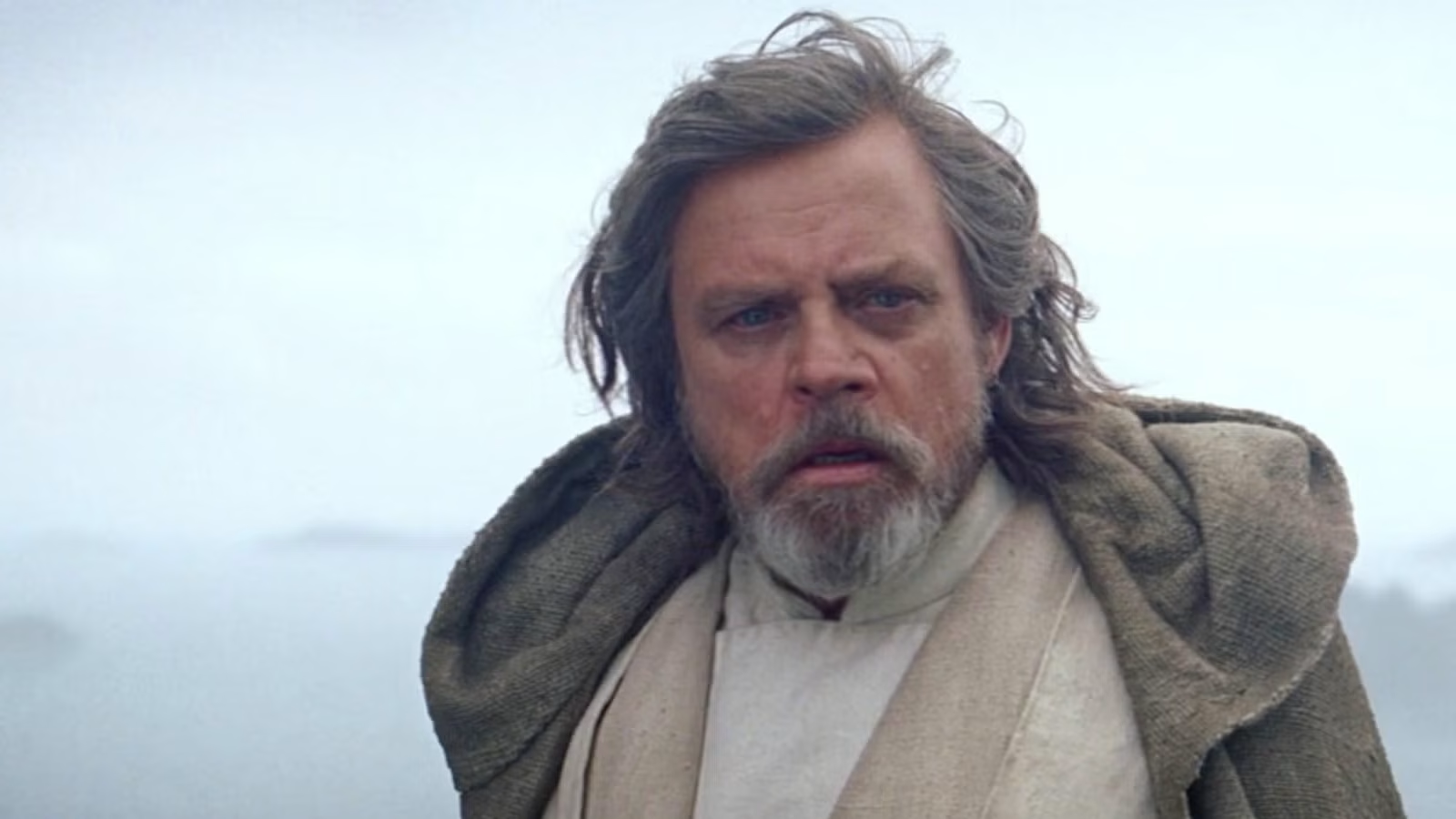
One of the big things that many fans take offense with is the idea that Luke would run away from his problems — specifically his failing of young Ben Solo — but Luke has never exactly been adept at confronting issues and challenges when they’re personal. The biggest example of this comes in The Empire Strikes Back. In that film, Luke is on Dagobah getting training from Master Yoda when he gets a premonition of Han Solo and Leia in trouble. Now, keep in mind that at this point in his training Luke is still struggling to an extent. He’s having issues controlling his anger, he’s not dealing with his impulsiveness well, and while things are starting to gel for him, he is arguably in the thick of the most personally challenging part of his training.
So, when Luke finds out that his loved ones are in trouble, he bolts to help them — even though both Yoda and Obi-Wan tell him that it’s the wrong thing to do. Sure, there’s something to be said for wanting to help your friends in trouble, but when you pair that with Luke already being shown to have issues with impulse control and not really being able to confront his own weaknesses with his very wise teacher flat out telling him he needs to not go and just let them handle things on their own, you get a look at a Luke that runs from personal challenges. It has echoes back to the very first film, even, when he also just leaves Tatooine after finding out his family had been killed. Luke runs when it’s personal.
Flash forward to Ahch-To. After what happened with Ben Solo, instead of facing what happened and his own failings in the matter, Luke runs. He’s not isolated on Ahch-To because of some formal punishment; Luke’s exile is self-imposed. He chose this and, later, when Luke goes to burn the Jedi library and hesitates, the spirit of Yoda appears and does it for him, telling Lue that he needs to learn from his failure. Even Force Ghost Yoda is calling Luke out for avoiding the hard lessons. It’s a strong reminder that while Luke is a hero and an impressive Jedi, he’s also someone who just hasn’t really done the personal work to face his inner weaknesses and, thus, running away isn’t out of character at all.
This also connects to the very controversial moment in the film when Luke throws away his lightsaber. It’s a move that can be read as impulsive — something that we already know that Luke has demonstrated being. It’s also serves to remind viewers that Luke is very much his father’s son as a certain other Skywalker was impulsive. They just happened to turn to the Dark Side.
Luke’s Sacrifice is Also Perfectly In Character (And Completes His Journey)
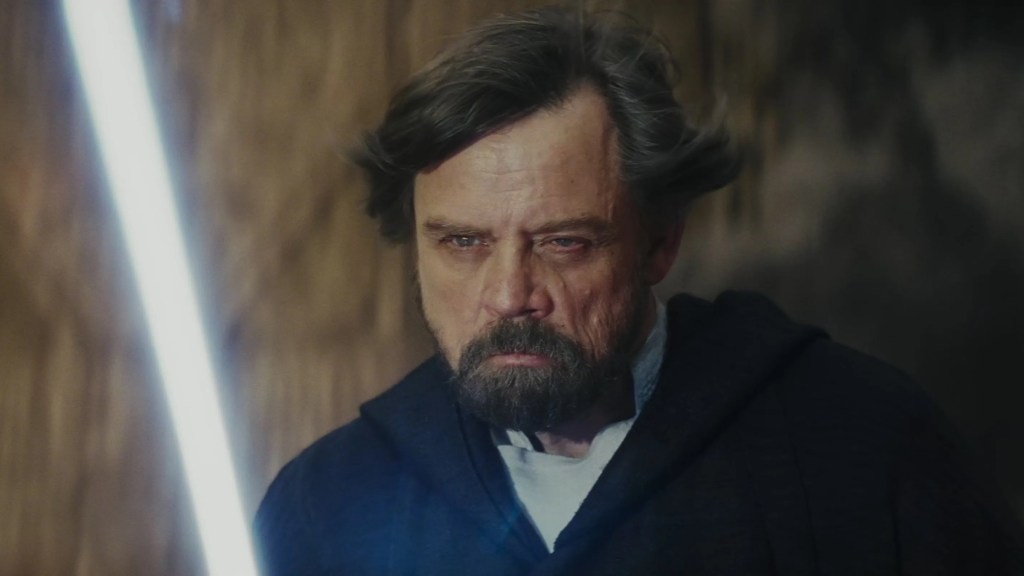
The other thing that fans see as being just wrong about how The Last Jedi portrayed Luke is how he finally does engage in the fight against the First Order. While fans have issues with it, mechanics aside, the idea that Luke would eventually come around to do the right thing is also really in line with who Luke is — while also telling a larger human story. In the original trilogy one thing that is consistent with Luke is that, despite being impulsive and not necessarily that great at dealing with his personal challenges and weaknesses, he does always show up when it counts and that’s what we see here. After being chastised by the spirit of Yoda, Luke has clearly (and finally) realized that the only way out his through and by that, I mean that he learns he has to act and can’t just wallow in his own pain and avoidance. By showing up for the Resistance, he’s showing that he has in fact finally faced his failures.
And if you look at Luke’s story through the lens of the Hero’s Journey, it all fits just not necessarily in the order you might expect. Most people who look at The Last Jedi expect that Luke’s heroic journey ended with the end of the original trilogy (he went off on his adventure, he faced trials in the unknown, he came back transformed and mastered a final test bringing benefit to his community). But nothing says that the journey is a straight line (or circle, if you’re used to seeing it graphically displayed that way in lit class). The reality is that the end of the original trilogy was only the midpoint of Luke’s journey: he confronted his greatest enemy and gained his prize. It wasn’t the only confrontation, though. Luke’s real test was that moment aiding the Resistance. If you look at the events of The Last Jedi as the “return” part of Luke’s heroic journey, the events with Ben Solo transformed him and he had to journey his way back “home”. In the end, he had his final test, completing his journey and bringing “boon” to his community in facilitating the Resistance’s ability to rise again.
While there are many things about The Last Jedi that perhaps do deserve criticism, how it portrays Luke Skywalker is not one of them. While we as fans have always idealized the humble farm boy who became a legendary Jedi as being a Big Damn Hero, we’ve also forgotten to humanize him with his well-defined flaws. It’s kind of like realizing that someone you respect is a person just like you are: it’s hard to imagine them as anything but perfect. But, Luke Skywalker, even as a master Jedi, is flawed and The Last Jedi beautifully leaned into that while also giving us the greatest thing any hero could want: genuine redemption.
What do you think? Leave a comment below and join the conversation now in the ComicBook Forum!