
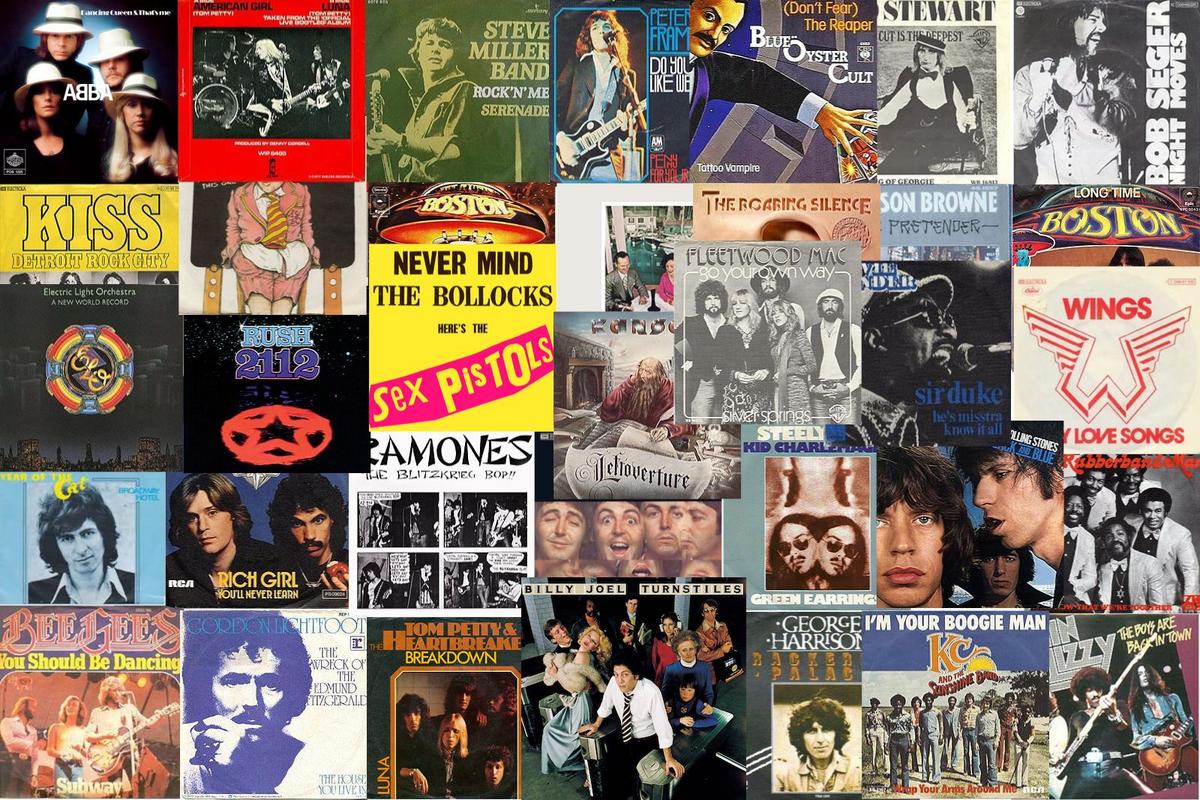
The year before punk broke, rock’s old guard made a strong, pressing stand.
But as the UCR staff-selected list below of the Top 40 Songs of 1976 shows, the music that dominated headlines at the end of the decade was starting to make a pass in the fast lane.
You’ll find pop, disco, soul, punk, folk and progressive sounds mixed among the rock songs. It was an eclectic year, on the verge of something new and possibly bigger than the guitar-driven rock ‘n’ roll that steered much of the first half of the ’70s. For now, though, familiar names are mostly at the forefront.
40. Gordon Lightfoot, “The Wreck of the Edmund Fitzgerald” (From Summertime Dream)
Who would have expected a six-minute folk song about a ship that sank in Lake Superior in 1975, told in a medieval ballad style, to become a No. 2 single in 1976? Gordon Lightfoot’s “The Wreck of the Edmund Fitzgerald” spins its narrative — 29 crewmen died in the accident — in such compelling fashion that the song gave the Canadian singer-songwriter one of the biggest hits of his career. It still haunts.
39. Wings, “Silly Love Songs” (From Wings at the Speed of Sound)
From the opening factory hisses to the unaffected “I love you”s that turn up throughout the song, Wings’ “Silly Love Songs” is in on the joke (note the winking title). That it’s blanketed in one of Paul McCartney’s greatest ’70s melodies removes any criticism the hit single weathered then and now. It also masks its perceived simplicity with a multitude of hooks that reveal new layers as the song progresses. It’s pure genius.
38. KC and the Sunshine Band, “I’m Your Boogie Man” (From Part 3)
KC and the Sunshine Band arrived at the disco party early, scoring three No. 1 songs before Saturday Night Fever took the genre mainstream. (Their 1975 song “Boogie Shoes” was included in Saturday Night Fever.) So when they released “I’m Your Boogie Man,” a tribute to a local Miami DJ who helped break the group in its early days, as a single from their 1976 album Part 3, it had no problem maintaining the streak.
37. Manfred Mann’s Earth Band, “Blinded by the Light” (From The Roaring Silence)
Partly inspired by a Supertramp keyboard riff and written by Bruce Springsteen four years earlier, Manfred Mann’s Earth Band’s “Blinded by the Light” added a progressive take (running more than seven minutes on The Roaring Silence) to the Boss’ folk-rock debut opener. Misheard lyrics, due to a technical mishap during recording, have made this a somewhat controversial cover; nonetheless, Springsteen’s only No. 1 as a writer.
36. The Rolling Stones, “Memory Motel” (From Black and Blue)
Black and Blue’s best song isn’t the cool disco thumper “Hot Stuff” or even the sobby soul ballad “Fool to Cry.” The closest the Rolling Stones’ 1976 LP gets to perfection is on another ballad, the equally soulful “Memory Motel.” Featuring co-lead vocals by Mick Jagger and Keith Richards, one of the rare times the Glimmer Twins shared a mic, the seven-minute song’s guitars are by guests Harvey Mandel and Wayne Perkins.
READ MORE: Top 30 Albums of 1975
35. Paul McCartney and Wings, “Let ‘Em In” (From Wings at the Speed of Sound)
The list of names Paul McCartney rattles off in “Let ‘Em In” was, for the most part, real people in his life: an aunt, a brother and his wife Linda’s brother. Phil and Don Everly, early influences on the Beatles and later recipients of a new McCartney song for their 1984 comeback album, are also mentioned. The second single from Wings’ fifth album, Wings at the Speed of Sound, reached No. 3, McCartney’s 12th post-Beatles Top 10.
34. England Dan & John Ford Coley, “I’d Really Love to See You Tonight” (From Nights Are Forever)
England Dan & John Ford Coley had some history before they landed their first hit single in 1976. They started in a psych-pop group together while teenagers in Dallas, opening for Led Zeppelin and others. England Dan Seals’ older brother was one-half of ’70s hitmakers Seals & Crofts. The radio-ready soft-rock “I’d Really Love to See You Tonight” kicked off a string of Top 40 hits that continued through the end of the ’70s.
33. George Harrison, “Crackerbox Palace” (From Thirty Three & 1/3)
George Harrison’s “Crackerbox Palace” is loaded with in-jokes and references to Harrison’s post-Beatles life, including the song’s title (Crackerbox Palace was the name of Harrison’s home, itself named after comedian Lord Buckley’s residence); a tossed-off quote from Blazing Saddles during the instrumental break; and a promo clip with friends Eric Clapton, future Rutle Neil Innes and Monty Python’s Eric Idle, who directed.
32. Spinners, “The Rubberband Man” (From Happiness Is Being With the Spinners)
Spinners’ “The Rubberband Man” has had a second and even a third life since its debut in the summer of 1976. Over the years, the Philly soul song has been used in movies (its appearance in 2018’s Avengers: Infinity War made it popular with new generations), TV shows and commercials. Legendary songwriter Thom Bell cowrote “The Rubberband Man” for his son, who was teased because of his weight. It was a No. 2 hit.
31. Rod Stewart, “The First Cut Is the Deepest” (From A Night on the Town)
Cat Stevens wrote “The First Cut Is the Deepest” in 1965 and included the song on his second album in 1967, the year R&B singer P.P. Arnold had a Top 20 U.K. single with it. Almost a decade later, Rod Stewart recorded a version for his 1976 album A Night on the Town, which has become the new standard, laying the blueprint for future covers, including Sheryl Crow’s 2003 hit. Stewart’s sublime version remains near definitive.
30. Boston, “Foreplay/Long Time” (From Boston)
“Foreplay,” the two-and-a-half-minute instrumental that precedes “Long Time” on Boston’s self-titled debut album, was the first song band architect Tom Scholz wrote and recorded when he started to assemble the record in his basement. The soft-roiling intro leads to the FM-radio blast of “Long Time,” one of the group’s most efficient and popular songs. The multilayering of guitars builds toward a majestic finale.
29. Bee Gees, “You Should Be Dancing” (From Children of the World)
The song that transformed the Bee Gees into a full-force disco act preceded the success they’d have a year later with Saturday Night Fever. But “You Should Be Dancing” didn’t arrive without warning: In 1975, the Gibb brothers lodged their first No. 1 since 1971’s “How Can You Mend a Broken Heart” with “Jive Talkin’.” As a centerpiece to the 1977 film, “You Should Be Dancing” ignited disco as much as “Stayin’ Alive.”
28. Steely Dan, “Kid Charlamagne” (From The Royal Scam)
The opening song on Steely Dan’s fifth album, The Royal Scam, is textbook Dan in its crafty wordplay (Walter Becker and Donald Fagen wrote “Kid Charlamagne” about LSD guru Owsley Stanley) and dexterous music bed. But it’s Larry Carlton’s nearly minute-long guitar solo that ranks “Kid Charlamagne” as one of Steely Dan’s greatest achievements. The celebrated liquid solo scales the chasm between jazz and pop.
27. Rush, “2112” (From 2112)
The side-long, seven-part, 20-minute suite that opens Rush’s breakthrough fourth album is peak mid-’70s progressive rock. “2112” has got it all: a sci-fi concept, ultra-tricky musical pieces and distinct sections that range from epic (“The Temples of Syrinx”) to an instrumental passage that attempts to tie up its loose themes (“Grand Finale”). The Canadian trio found their voice on this mounting, galvanizing epic.
26. Led Zeppelin, “Nobody’s Fault but Mine” (From Presence)
Returning to the blues songbook that was integral to their early career, Led Zeppelin’s reworked take on Blind Willie Johnson’s “It’s Nobody’s Fault but Mine,” featured on Presence under the shortened title, fits snugly into the LP’s bulldozing hard rock. Robert Plant was recovering from a car accident at the time of recording, but his blues-rock growl rings with an intense authenticity. It’s a commanding performance top to bottom.
25. Billy Joel, “New York State of Mind” (From Turnstiles)
Between his first real hit, “Piano Man,” and the album that would take him to new levels of success, The Stranger, Billy Joel sharpened his songwriting narrative on Turnstiles. While never released as a single, the album’s standout song, “New York State of Mind,” has taken on new lives since its release in 1976. Covered by Barbra Streisand, a live favorite and a post-9/11 anthem — it’s one of Joel’s most durable compositions.
24. Tom Petty and the Heartbreakers, “Breakdown” (From Tom Petty and the Heartbreakers)
Tom Petty and the Heartbreakers’ debut single, “Breakdown,” began as an extended jam that ran more than seven minutes, which is often reproduced in live versions. Shortened to less than three minutes for release, the track served as an introduction to a group whose self-titled debut album swerved from chiming ’60s folk to ’70s FM radio rock to on-the-horizon new wave. It peaked at No. 40 and launched his career.
23. Daryl Hall & John Oates, “Rich Girl” (From Bigger Than Both of Us)
The first of Daryl Hall & John Oates’ six No. 1 singles was written about a former boyfriend of Hall’s girlfriend at the time, herself a frequent songwriting collaborator of the duo and the inspiration behind their first hit, “Sara Smile.” Hall changed the subject’s gender of “Rich Girl,” noting that the swap was a better fit for the song’s tone. At two and a half minutes, “Rich Girl” wastes no time getting to its lyrical and melodic point.
22. Steve Miller Band, “Rock’n Me” (From Fly Like an Eagle)
The second of Steve Miller Band’s three No. 1s was written by the bandleader in haste after he was tapped to play a one-off show with Pink Floyd in London in 1975. Wanting a song that would show up the openers onstage, Miller penned “Rock’n Me” as a festival anthem that name-checked several U.S. cities, including Phoenix, Philadelphia and Atlanta. It soon became a live favorite at Miller’s concerts, where it stayed for years.
READ MORE: Top 50 Hard Rock Songs of the ’70s
21. Al Stewart, “Year of the Cat” (From Year of the Cat)
“Year of the Cat” is filled with mysteries. The person at the center of Al Stewart’s winding narrative strolls through a foreign market, meets a woman and is persuaded to stay his visit. All of this unspools over six and a half minutes, with an engaging backdrop of strings, saxophone and keys underscoring Stewart’s enigmatic story song, which memorably mentions 1940s noir actor Peter Lorre, surely the only Top 10 hit to do so.
20. Bob Seger & the Silver Bullet Band, “Night Moves” (From Night Moves)
Bob Seger’s nostalgic look back at the early 1960s is set in the middle of America’s heartland at a time in a young man’s life when not much mattered more than plans for Saturday night. At times wistful (“When you just don’t seem to have as much to lose”) and romanticized, “Night Moves” sways through the parking lot, haunted by ghosts of past hopes and dreams. The song and its parent album made Seger a star.
19. Ramones, “Blitzkrieg Bop” (From Ramones)
Punk was still a year or so away from declaring its takeover, but Ramones’ self-titled debut album, released in April 1976, launched a first shot. The opening song, “Blitzkrieg Bop,” announced itself from the start: 132 seconds of buzzsaw guitar, irrational lyrics and a career-defining chant inspired by the Bay City Rollers. The band would rarely break from the template over the next two decades, though they’d never be as pivotal.
18. Jackson Browne, “The Pretender” (From The Pretender)
The title track of Jackson Browne’s fourth LP earns its place as the closing song. Observing the disillusionment of his collective generation, “The Pretender” is both autobiographical and a scarred portrait of the author as he views himself and his fellow survivors. There’s a whiff of idealism as Browne draws the song to a conclusion after six minutes; in the end, he’s living outside a dream, wondering where he went off course.
17. Electric Light Orchestra, “Livin’ Thing” (From A New World Record)
From the tuning-up strings that open the song to the minor-key shift that welcomes the chorus, “Livin’ Thing” has long ranked as one of Electric Light Orchestra’s best songs. The lead single from A New World Record features one of the group’s brightest hooks, a radio pop gem that may be their greatest moment. It’s certainly endured over the years: See the closing scene of Paul Thomas Anderson’s staggering Boogie Nights.
16. Sex Pistols, “Anarchy in the U.K.” (From Never Mind the Bollocks, Here’s the Sex Pistols)
Not the first “punk” single, but close to it. The Sex Pistols’ debut single, “Anarchy in the U.K.,” arrived in November 1976 and changed the way records were recorded, performed and marketed. The initial blast sparked a revolution, especially in the U.K., where bands flocked to record labels in hopes of making it big. “Anarchy in the U.K.” peaked inside the U.K. Top 40; within a year, there was no escaping its influence.
15. Kansas, “Carry On Wayward Son” (From Leftoverture)
U.S.-based prog acts were few and far between in the ’70s; Kansas was among the few American bands striving during this period. Their fourth album, Leftoverture, included several lengthy and multipart songs, but it’s the relatively tight album opener “Carry On Wayward Son” that introduced them to mainstream audiences in 1976. The song just missed the Top 10, but the album went to No. 5, forever changing their destiny.
14. Boz Scaggs, “Lowdown” (From Silk Degrees)
Boz Scaggs had been around since the mid-’60s, when he released his first album and was a member of the Steve Miller Band. But it wasn’t until he remade himself into a voguish blue-eyed soul singer that his career hit new heights. Recorded with some of the top session players in Los Angeles (who would form the basis of Grammy winners Toto), Silk Degrees is slick, flawless disco pop. “Lowdown” is the album’s peak.
13. Thin Lizzy, “The Boys Are Back in Town” (From Jailbreak)
Call it the luck of the Irish: Thin Lizzy didn’t initially short-list “The Boys Are Back in Town” for placement on their sixth album. After two U.S. DJs began playing the song, it caught on and generated renewed interest in Jailbreak, keeping the on-the-verge-of-breaking-up group from breaking up. “The Boys Are Back in Town” became the Dublin band’s only Top 40 single in the States, while Jailbreak was their highest-charting LP.
12. Blue Oyster Cult, “(Don’t Fear) The Reaper” (From Agents of Fortune)
Even though it’s now better known as the song in Saturday Night Live’s famous cowbell sketch, Blue Öyster Cult’s “(Don’t Fear) The Reaper” had sealed its real legacy among music fans decades earlier. Written as words of comfort for those afraid of dying, the song was circled in an almost dreamlike haze, more hook-driven pop than the New York band’s usual hard-rock punch. And yes, that cowbell is quite marvelous.
11. Kiss, “Detroit Rock City” (From Destroyer)
The opening song on the first of two Kiss albums released in 1976 (Destroyer, out in March) was written about the Midwest city, one of the first to embrace the band. Look beyond the “Everybody’s gonna move their feet / Everybody’s gonna leave their seat” platitudes of “Detroit Rock City,” though, and a darker song lurks, based on a true incident of a fan who was killed in a car accident on his way to a Kiss concert.
10. Boston, “More Than a Feeling” (From Boston)
When it arrived during the final few weeks of summer 1976, Boston’s debut album was an unexpected hit, going gold within its first two months and platinum by the end of the year, on its way to becoming one of the biggest-selling first albums ever, a distinction that remains. Its lead single, the pop-hook-meets-rock-riff “More Than a Feeling,” reached the Top 5 and was a key component in the band and album’s lasting success.
9. AC/DC, “Dirty Deeds Done Dirt Cheap” (From Dirty Deeds Done Dirt Cheap)
First released on the 1976 version of AC/DC’s Dirty Deeds Done Dirt Cheap (later reconfigured for the U.S. market after singer Bon Scott died), the title song is one of the Australian band’s most enduring singles. Guitarist Angus Young borrowed the title from the 1960s cartoon Beanie and Cecil, which featured a main villain who used the phrase as his motto. The oily menace and tongue-in-cheek sleaze are all Scott’s, however.
8. Aerosmith, “Back in the Saddle” (From Rocks)
The galloping horses introduced in the opening song of Aerosmith’s fourth album, arriving a year after the breakthrough Toys in the Attic, are met with equal determination by the band in one of its most ferocious records. “Back in the Saddle” is both a statement and an affirmation; by the time Steven Tyler breaks into a yodel near the end of the song, Aerosmith, with Rocks, had secured their spot at the hard rock summit.
READ MORE: Top 40 Songs of 1975
7. Tom Petty and the Heartbreakers, “American Girl” (From Tom Petty and the Heartbreakers)
A delayed hit that keeps getting better over time, “American Girl” didn’t even dent the charts when it was released as a single from Tom Petty and the Heartbreakers’ debut album. Recorded on the Fourth of July and brilliantly used in the end credits of the 2025 film One Battle After Another, “American Girl” wears its stars and stripes proudly, if a bit meekly. “Raised on promises” comes loaded with suggestions; the hook never gives up.
6. Peter Frampton, “Do You Feel Like We Do” (From Frampton Comes Alive!)
“Do You Feel Like We Do” first appeared on former Humble Pie guitarist Peter Frampton’s second solo album, Frampton’s Camel, in 1973. But it’s the audience-punched concert version of 1976’s Frampton Comes Alive! that helped make him a worldwide superstar. Unraveled at a slowly coaxed pace, stretched to 14 minutes as the set closer, the live “Do You Feel Like We Do” is all talk box and star appeal.
5. Fleetwood Mac, “Go Your Own Way” (From Rumours)
Released during 1976’s final weeks as a preview of the follow-up to Fleetwood Mac’s chart-topping 1975 album, “Go Your Own Way” revealed the romantic tangles at the center of the soon-to-be-unveiled Rumours. Lindsey Buckingham’s lyrics (aimed at former romantic partner Stevie Nicks) and guitar solo both sting. Also noteworthy is Nicks’ non-LP “Silver Springs” found on the B-side — same story, different perspective.
4. Led Zeppelin, “Achilles Last Stand” (From Presence)
Led Zeppelin’s most prog-like album begins with this galloping 10-minute parable inspired by Greek mythology and English poet William Blake. Presence arrived during a transitional period for the band, which had been touring nonstop since the late ’60s and was on break, in part to give Robert Plant time to recover from a car accident. The result is one of Zeppelin’s most charging, thundering cuts. It’s Jimmy Page’s favorite.
3. ABBA, “Dancing Queen” (From Arrival)
“Dancing Queen” was somewhat of an unlikely global No.1, a pop hit that begins with its chorus, a disco song with slower-than-average beats per minute. Structurally, it’s a marvel, building on its Europop foundation by wrapping it in borrowed Phil Spector-like production and a flawless hook, effortlessly navigated by ABBA’s two female singers. “Dancing Queen” celebrates the joy of giving in; decades later, its pull is irresistible.
2. Stevie Wonder, “Sir Duke” (From Songs in the Key of Life)
A music legend pays tribute to other legends in one of 1976’s most joyful songs. Stevie Wonder’s double-LP-plus-EP Songs in the Key of Life was declared a masterpiece from the day of release, and “Sir Duke,” the album’s second single and second No. 1, gives a history lesson in four glorious pop-soul minutes. Louis Armstrong, Count Basie, Ella Fitzgerald, Glenn Miller and, of course, Duke Ellington are dutifully saluted. Luminous!
1. Eagles, “Hotel California” (From Hotel California)
Los Angeles’ dark underbelly is exposed in the most desolate of Eagles songs, a dark, bleak epic that holds a mirror to the band and their community’s bad habits. “Hotel California” isn’t a cautionary tale as much as it’s a survey of the damage already done; it’s too late to turn back now, the song says, so hold on tight through the final turns. A much-celebrated guitar solo (played as a duet between Don Felder and Joe Walsh) draws the song to a close; the steps leading to that point — dark desert highways, voices calling in the middle of the night and steely knives — are accented by the high-living Californians’ version of reggae. “Hotel California,” as the opening track on the Eagles’ best album, sets the tone; from here on out, everything peels another layer of despair from the facade.
From Eagles and Led Zeppelin to Aerosmith and Stevie Wonder: The Top 40 Albums of 1976
As the decade turned a midpoint corner, some of the biggest artists of the ’70s reached their stride.
Gallery Credit: Michael Gallucci