
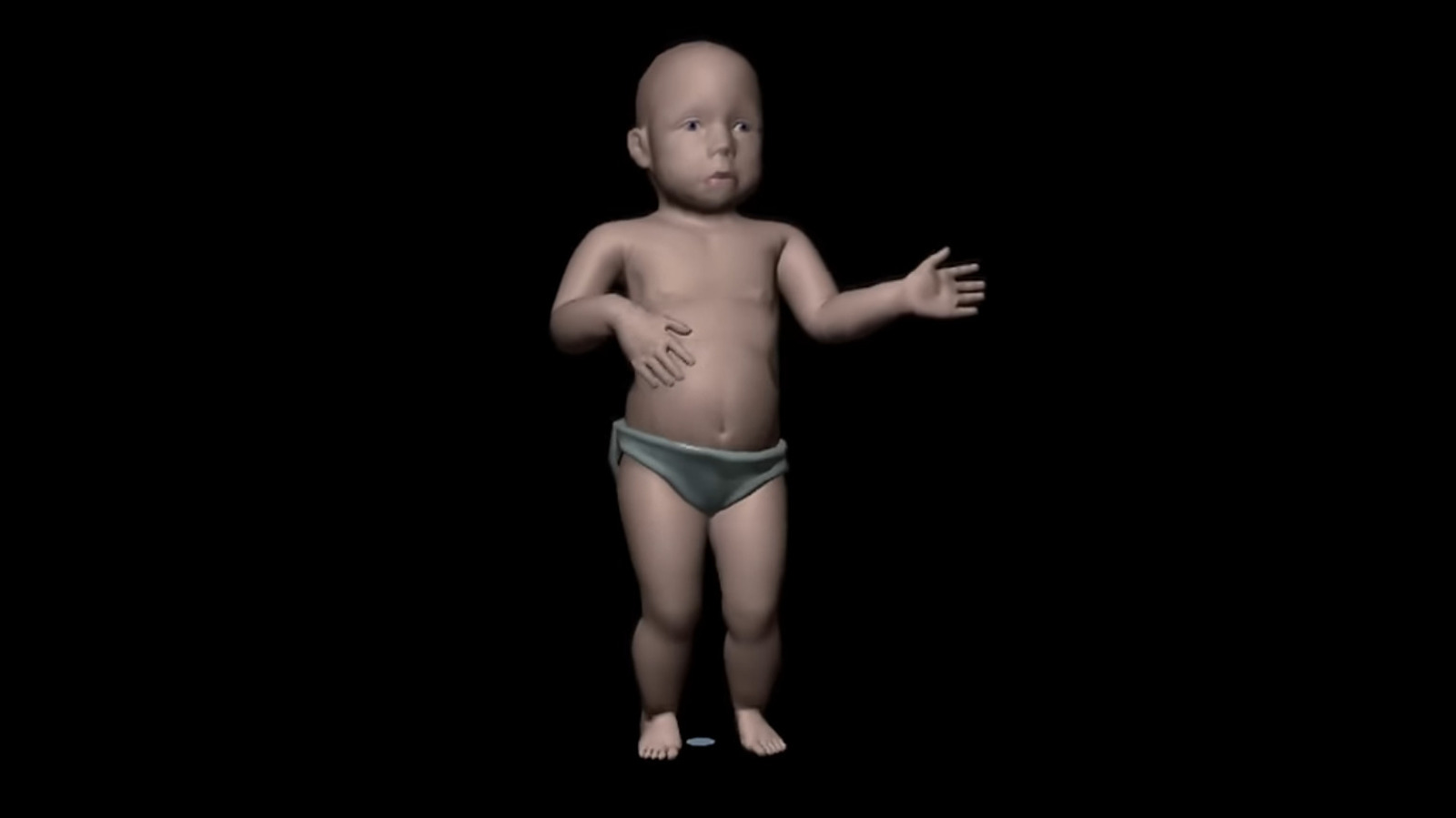
In many ways, “Ally McBeal” is one of the most quintessentially 1990s TV shows, what with all the pantsuits, gender politics, and legal drama the buzzy Calista Flockhart vehicle can throw at you. Created by David E. Kelley, the Fox drama follows the titular lawyer as she navigates all the romantic and personal drama that eruptes within the walls of her Boston legal firm, Cage and Fish. In some ways, the series represents a turning point in culture, from the heydays of the 1990s to the interconnected world of the 2000s. And nowhere is that better encapsulated than in the story of the Dancing Baby, one of the internet’s very first memes.
In 1995, Robert Lurye, an animator at VFX house Rhythm & Hues, picked up a freelance job to create various skins for a program of a dancing human skeleton. According to a Lurye interview with Vulture, he made “five or 10” of these skins, including “a weird purple alien,” a chicken, and, of course, one dancing baby. When the program’s creators realized “how disturbing it was” (via New York Times) to see a baby moving with such an unnatural rhythm, they set the dancing baby aside. Eventually, a LucasArts animator found the file on the company servers and uploaded the resulting animation to a CompuServe forum.
In an all too familiar story, the low-polygon dancing baby was passed from one e-mail address to another, and one of the first bona fide memes was born. But how did the baby dance its way onto “Ally McBeal”?
Ally McBeal turned the meme into a metaphor for her biological clock
Like many other bosses across America in 1995, David E. Kelley was shown the video of the dancing baby on his assistant’s computer. And as soon as he saw the virtual infant boogying to “Hooked on a Feeling,” according to The Hollywood Reporter, Kelley asked, “How do we get it into the show?”
He found the perfect role for Baby Cha in the show’s 12th episode, “Cro-Magnon,” when 20-something Ally McBeal struggles to control her ticking biological clock as it forces her to reconsider whether or not she wants to have a baby while juggling the complexities of her legal career. This was a realistic and emotionally charged storyline for a lot of women in the audience, who, in the ’90s, were asking themselves the same question: Can you — or do you even want to — have it all?
Enter: Baby Cha. “It may have been terrifying and hypnotic but it was also perfect for Ally,” Kelley said. “It tapped into her internal war. She knew that on paper, a woman her age was supposed to be married with a child, but that wasn’t how she felt she wanted to be. The Dancing Baby represented that feeling.”
Flockhart was shown the animation and the rest is TV history. It’s hard to believe there was a time when something like this was unheard of, but by jumping from the internet onto network TV, the dancing baby became the first of many memes to cross over into national prominence. Nowadays, pop culture shifts so quickly that by the time a meme can make it to TV, a dozen others have already popped up in its place. But thanks to “Ally McBeal,” Baby Cha will always be famous.
.png "Doc – Episode 2.20 – The Big Chair – Promotional Photos + Press Release")