

Posted in: Comics | Tagged: Alan Moore, I Hear A New Sound, long london, The Great When
Alan Moore reveals the names of all of his Long London novels…. but has no idea what he’s going to do next…
Article Summary
Alan Moore unveils titles and themes for all five novels in his Long London fantasy series.
The books blend post-war London history, occult world-building, and psychogeographic magic.
Key historical events like the Notting Hill riots become part of Moore’s shadow-London narrative.
Long London explores how language, magic, and consciousness shape reality across decades.
Ahead of the release of the second of his Long London novels (I have read and reread the first, The Great When with glee}, and I Hear A New Sound scheduled for this May, Alan Moore has provided the clearest roadmap yet for the remaining books, in an interview with RetroFuturista calling the project his deep dive into “total fiction.” The series, which blends heavily researched post-war London history with occult world-building and psychogeographic magic, follows interconnected characters across a secret, shadow version of London called The Great When, both formed by and forming the general everyday London that most people see. It’s somewhere between his Nighthampton and Neverwhere, with Ian Sinclair as tour guide. Moore has laid out the five-book arc by titles… but what can we work out from what we know?:
The Great When (2024) — Set in the immediate post-war years, introducing readers to the fantastical “Great When,” a version of London existing outside ordinary time and space. Here, abstract ideas manifest as living creatures, and the streets twist into fourth-dimensional paths. Protagonists like the hapless Dennis Knuckleyard cross between worlds, and we meet real life London characters from the time such as Joe Spot, Arthur Machen, Austin Osman Spare, Jack Comer, and Ras Prince Monolulu
I Hear a New World (May 2026) – Set almost ten years after the first novel, in 1958, this sees Grace Shilling find her way into The Great When, a parallel version of London, with Dennis Knuckleyard following her. It takes its title from the album by Joe Meek, recorded in 1959. One of the most influential record producers and sound engineers of all time, he is best known for the Tornados’ 1962 track, “Telstar.” He is also infamous for killing his landlady and then shooting himself in 1967.
Blow Away, Dandelion – set in the late sixties. From a lyric from the Rolling Stones 1967 song, Dandelion with John Lennon and Paul McCartney singing backing vocals
In England’s Dreaming – set in London’s punk seventies, the title referring to the Sex Pistols song God Save The Queen, released for Queen Elizabeth II Silver Jubilee in 1977 and kept off the number one chart spot through shenanigans.
And No River Of Fire – set in 1999, on the eve of the Millennium, with a title reference to the pyrotechnic event that was meant to rush up along the Thames on the stroke of midnight, but that was more of a damp squib as everyone missed it.
Moore described the overall project as tracing a “secret history” of London across the latter half of the 20th century, merging deep historical research with high-concept fantasy. The shadow-London serves as a stage where linguistic magic, psychogeography, and the blurred line between reality and fiction take center stage, reminding us that “Magic and the arts, particularly writing, are to all intents and purposes synonymous” and that “A piece of fiction is, from birth, indistinguishable from a spell, at least if that is its intention.” He defines magic broadly as “any purposeful engagement with the phenomena and possibilities of consciousness,” positioning the quintet as an extended act of magical creation. The series explores how ideas themselves can become sentient forces, and how language shapes (and reshapes) reality, themes that echo previous work such as From Hell, Highbury Working, Providence and The Moon and Serpent Bumper Book of Magic. When asked about life after the quintet, Moore was candid: “I have genuinely no idea what I’ll be doing after that point, so we’ll all just have to wait and see.”
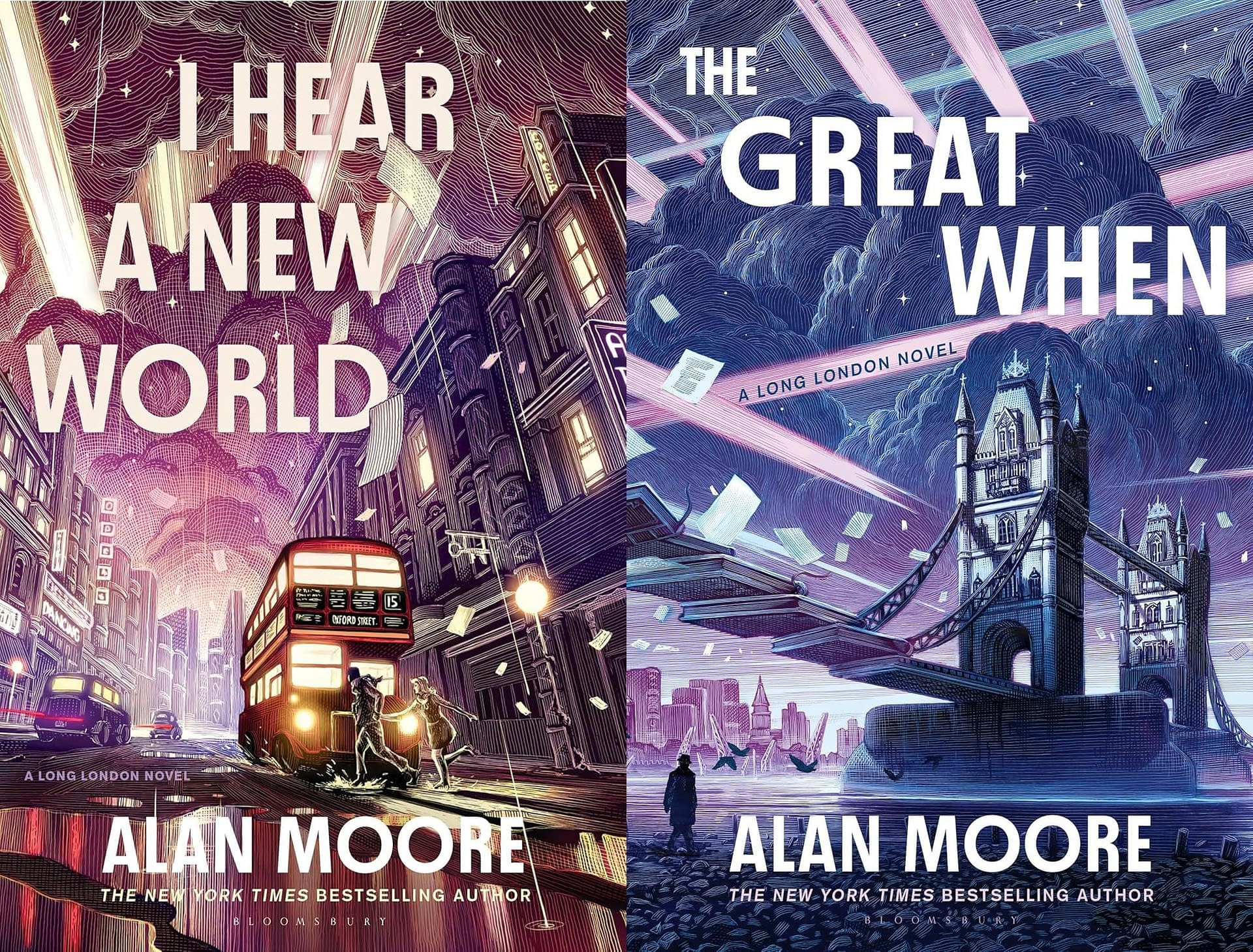
I Hear A New World by Alan Moore will be published on the 21st of May by Bloomsbury Archer in the USA and in the UK,
I Hear a New World – A daringly inventive fantasy novel about murder, mayhem, and magic from New York Times bestselling author and legendary storyteller Alan Moore. It’s 1958 and Dennis Knuckleyard has decided to leave his adventures in the Great When in the past where they belong. For nine years, he’s avoided so much as thinking about the magical version of London, until he rediscovers an unpleasant reminder of his last adventure-a key that he’d secretly brought into his own world from the other for safekeeping. But while Dennis may believe he’s done with the Great When, it’s far from done with him. When Dennis gives the key to a friend, its magical properties reawaken, bringing creatures from the other world into Dennis’s and sparking riots in Notting Hill. Even worse, Dennis’s old crush Grace Shilling has been forced into the Great When to investigate strange happenings in both cities. Desperate to keep Grace safe, Dennis follows her into Long London. But once inside the other city, it will not let him go away again so easily, and Dennis and Grace must fight to set things right in the Great When and their own world, or forever lose their lives-and each other. Full of Moore’s characteristically stunning world building and rollicking prose, I Hear a New World is the extraordinary second adventure in the Long London series.”
The Great When. – From the New York Times bestselling author and legendary storyteller Alan Moore, the first book in an enthralling new series about murder, magic, and madness set between two Londons-one recovering from World War II, and one a secret world unlike any other. In 1949, amidst the smog of London, Dennis Knuckleyard, a hapless eighteen year-old employed by a second-hand bookshop, discovers a novel that simply does not exist. It is a fictitious book, one only existing within another novel. Yet it is physically there in his hands. How? “Extraordinary . . . very funny . . . It does what fantasy does best which is show us something beyond our experience.” -Susanna Clarke, New York Times bestselling author of Piranesi and Jonathan Strange & Mr Norrell
The Notting Hill race riots of London took place in August and September, 1958, after a gang of white youths attacked a Swedish woman, for having a Jamiacan husband, and spread to a mob of hundreds of white people attacking the homes of West Indian residents, with many arrested, though police were criticised for not taking the issue seriously enough and denying the racial aspect of the attacks. A Caribbean Carnival, the precursor of the Notting Hill Carnival, was held in January 1959 in response to the riots. And just as the anti-fascist street battles of Cable Street became part of the fantasy narrative of The Great When, so it appears the Notting Hill riots will do the same.
Enjoyed this? Please share on social media!



Stay up-to-date and support the site by following Bleeding Cool on Google News today!