

Solar eclipses were once thought of as divine acts of destruction. The Choctaw Nation told stories of a massive black squirrel devouring the sun, while Hindu mythology pinned the astrological phenomenon on the celestial body Rahu swallowing that same massive star. Both, as echoed in many other cultures caught in the mysterious umbra, described these events as bad omens. Developer Housemarque’s Saros — named after the predictable period between eclipses — literalizes this ancient trend of interpreting solar eclipses as chaotic forces by turning its hostile alien planet into a downright hellish one once the sun is but a fiery rim around the moon. This process sadly also describes Saros, though, as its many failings and desperate attempts to be more forgiving have resulted in a disappointing experience that will forever be overshadowed by its spiritual predecessor, Returnal.
Like Returnal, Saros is a third-person shooter and roguelike hybrid that heavily calls upon Housemarque’s expertise in the arcadey bullet hell genre. Such a history gives Saros an immaculate mechanical foundation where precision is key. Evading is smooth and rife with enough precious invulnerability frames to make just about any threat manageable. Guns have punchy sound effects and dissolve any threat in a satisfying rain of various particles. Saros often floods the screen with enough orbs and visual debris that may make it seem like an unintelligible mess to the untrained eye, but clever use of colors means all of this chaos is legible.
Rating: 3.5/5
Saros‘ Bullet Hell Combat Feels Tight, but Is Sometimes Too Grindy
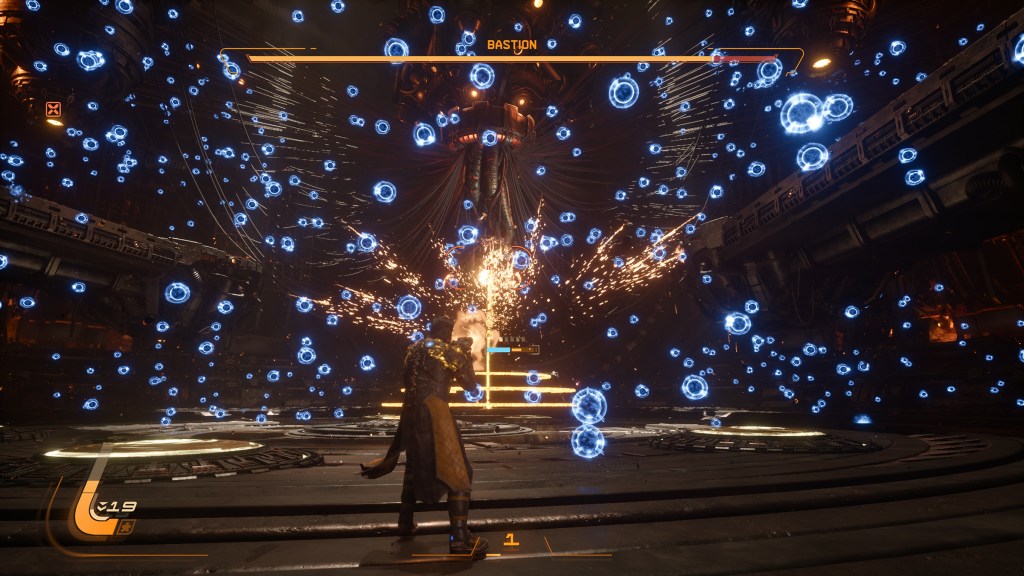
Colors are crucial to the shield and parry system that add more nuance to its intense bullet-laden battlefields. Blue orbs can be dodged through or absorbed in order to fuel power weapons, red orbs can be parried but not dodged through, and yellow orbs corrupt the player’s health bar upon contact but can be used to supercharge certain weapons. Having to quickly decide how to handle each type of orb is a thrilling process that turns each barrage into a choice. Is trying to absorb the rush of blue bullets followed by a pack of red ones going to be worth the risk? Is it better to just get out of the way of the incoming storm of red or is threading the needle and violently sending it back a gamble worth taking? The constant need to make split-second decisions like this while always under the gun is what makes Saros a lean-forward type of experience that beautifully demonstrates how to add strategy to a game that moves this quickly.
Saros is not merely just a third-person shooter, though, and is as much of a roguelike. However, its roguelike half undercuts its shooting elements through a suite of its inelegant and often conflicting elements. The skill tree at the heart of Saros is emblematic of many of its failures since it lays bare the game’s overall hyperfixation on stats. All of the little crystals that explode out of enemies can be used between runs in one of the most ludicrously padded skill trees this side of Assassin’s Creed Valhalla. An eyesore that only gets more ugly with time, this branching mess is mostly filled with bland upgrades that only boost stats. Actually interesting upgrades that add new functionality are lost in the scores of “+1 to [various stat]” nodes that clog everything up.
This addition injects some unnecessary grinding. Making too much progress too fast can result in a wall that comes in the form of bullet sponge enemies that can kill players in just a couple swipes. The former is a more egregious issue since some enemies can take multiple minutes to take down, a laborious process that waters down its aforementioned strengths. Bosses make this dynamic even more clear, as it’s possible to shoot at some bosses for, say, seven minutes straight and barely chip off a third of its health bar. When simple stat upgrades are added to a game like this, they become barriers to progress and artificially elongate the experience. Saros’ smooth controls allow it to excel based on skill alone, however, its focus on numbers undermines that.
Saros‘ Roguelike Qualities Have Been Downsized
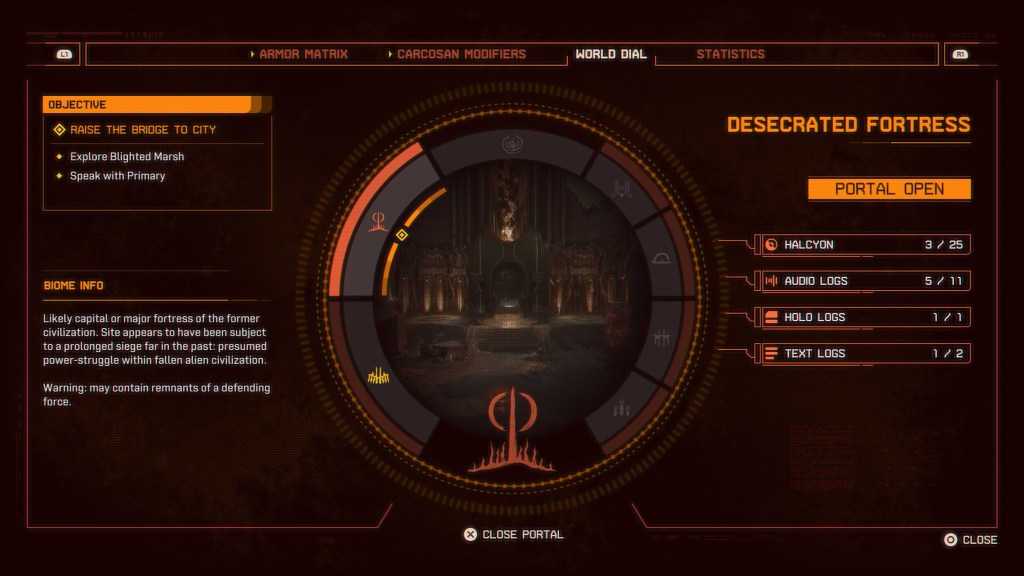
Many of Saros’ new systems also play a role in harming its roguelike center. Instead of having to start over after every death, players can teleport to each and any level and bypass the genre trope clearing the lower arenas to get to the later ones. While a novel idea in theory, this shortcut throws off the game’s difficulty curve on both ends of the spectrum.
By putting teleporters at the start of each stage with a bright yellow objective marker highlighting the most recent one, players are clearly incentivized to warp right into the newest biome and start wreaking havoc. But doing this after the first couple levels leads to tanky enemies that only disintegrate after clips upon clips have been emptied into them. It’s annoying and runs counter to the quick pace that represents the best part of its combat.
It then becomes clear that the best way to alleviate this pain point is to just start from the beginning and run through the stages in order each time, yet, crucially, this makes Saros far too easy. Since weapon power levels continue to climb the longer a run is, almost everything explodes in just a few bullets when starting from an earlier stage, trivializing the need to focus or play efficiently. Intimidating bosses who once soaked up every bullet on the alien planet of Carcosa will now perish with just a couple minutes of sustained fire.
This dynamic of extremes is a byproduct of Housemarque clearly trying to broaden Saros’ appeal after Returnal was appropriately labeled a tough game. And it doesn’t stop there, either. Most weapons have an aggressive auto-aim that can’t be switched off. An early upgrade grants players an extra life. New modifiers let players turn on a whole range of support systems that can nullify some damage, juice up each weapon, remove negative perks, and more. There are ones that make the game more challenging, too, but, in addition to not yielding more rewards, they’re hard to rely on in a game with such a sporadic and uneven difficulty curve. Even though the more traditional and appropriately labeled accessibility settings are welcome, these other types of changes made to whittle down the genre’s rough edges come together to form a game with a much less rewarding structure.
Saros Lacks the Hooks and Smoothness of Many Modern Roguelikes
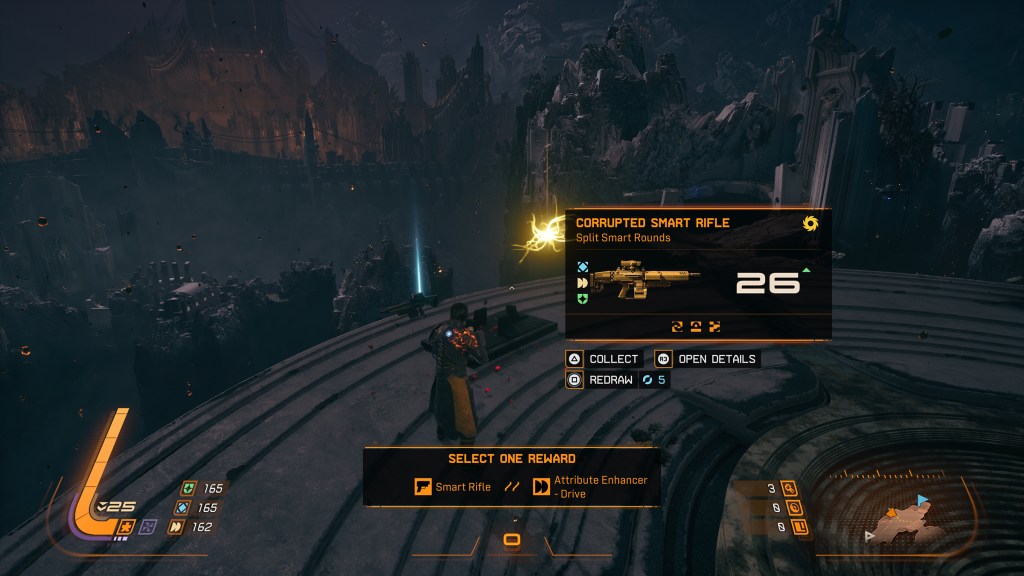
And, to make this shift more insulting, Saros’ roguelike elements have been scaled back, as well. There aren’t many ways to formulate a build, and the push toward shorter runs doesn’t yield much time to even make one. The equippable perks littered don’t even have very many synergistic qualities anyway. A majority of them also come with repugnant and heavy-handed downsides that sink their appeal, and there’s no way to unequip or swap them. There’s no shop to peruse; the Lucenite that pours out of slain foes only unlocks upgrades while back after base. Bosses don’t evolve from run to run, echoing the Saros’ grander issue of how it, unlike the genre’s best, doesn’t try to hook players and keep them coming back. Rooms repeat even more than they did in Returnal — one of its few downsides — and leave little space for surprises or new ways to earn gear.
Returnal was an excellent game, but it reflected Housemarque’s inexperience with the genre and demonstrated clear room for improvement. Roguelikes have flourished since Returnal‘s release and have provided plenty of valuable examples demonstrating how the team could have honed its technique in those ensuing years. But it hasn’t. The studio has instead opted to strip out systems, directly copy them over, or pare them back. Returnal, despite coming out exactly five years prior, is a deeper and more fulfilling roguelike. Sanding off the pricklier edges while also failing to move forward has made this disappointing outcome inevitable.
Saros‘ Story Is Uneven
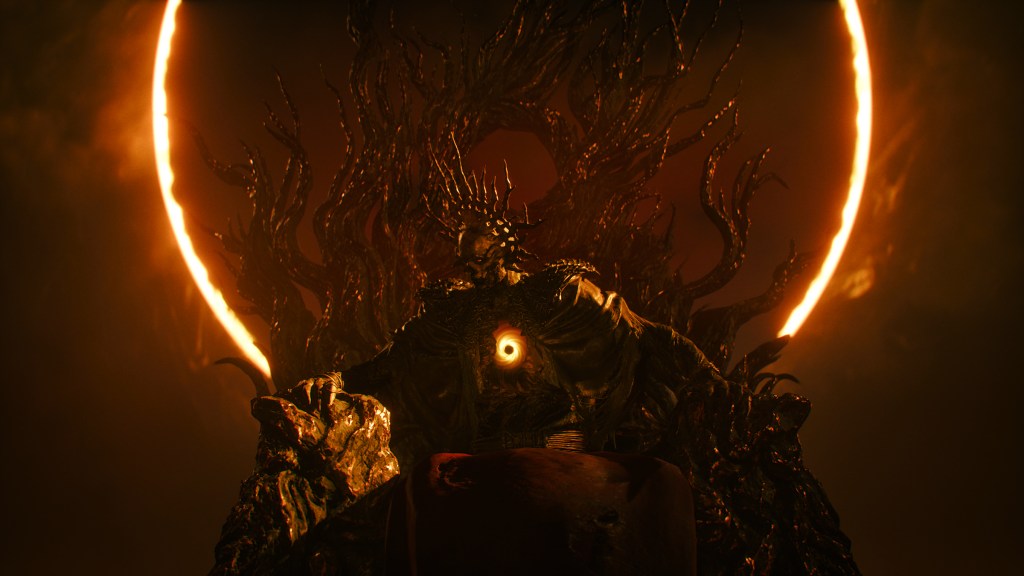
Saros’ narrative is similarly conflicted. The mystery that unfolds surrounding the megacorporation Soltari and its doomed venture to mine Carcosa’s Lucenite for the trillions it is worth poses a suite of amusing questions. Corporate chokeholds aren’t limited to just Earth, and protagonist Arjun, a gun for these ultracapitalist stiffs, has to contend with this overreach and profit-driven negligence at every turn. Saros uses this framework to dig into themes of control and power, weaving in a personal tale around Arjun and his need for penance.
Some of its cutscenes are confusing, as they are initially presented almost as non sequiturs players are meant to fill in later. The short vignettes of a dreamy past (or future) raise questions of what reality they stem from and how they relate to one another. One theory may start coming together only to be shattered by another obtuse revelation. The edges of the puzzle pieces are constantly shifting and hard to consistently fit together. While the lust for power and control is often at the center, the tertiary details aren’t as concrete. Returnal was also opaque at times and also took work to assemble, yet still yielded much more to latch onto and slightly clearer parallels to draw, achieving a nigh-perfect balance of revealing and withholding information.
Saros becomes a bit more understandable when taking one of its biggest inspirations into consideration. It is not shy about its reverence for Robert W. Chambers’ influential collection of short stories, The King in Yellow, often coming off as the lost interactive eleventh short story that came out 131 years after the original book. This comparison gives Saros’ story some recognizable anchors that make some points a little easier to connect. The presence of a mysterious king, people being driven to madness, a cursed amulet, and the corruptive influence of yellow (something cleverly echoed in Saros’ gameplay and story) are just a few of the overt similarities that use those original stories to provide scant amounts of clarity. Saros has an ending that is narratively betrayed by its roguelike qualities and is still too obtuse at times — a result of its bigger cast with multiple factions spread across time periods — but its proximity to The King in Yellow provides some support and adds some depth where it was only previously gestured at.
Even with these comparisons, Saros’ story remains an overall disappointment and is another reason why the game is an unsatisfactory follow-up to Returnal. Not only does Saros fail to build on what that 2021 title started, it takes massive leaps backward by having an unstable and frustrating difficulty curve, a less cohesive story, and shallower roguelike systems. Devoid of the context given by release dates, it would seem as though Saros came well before Returnal with how much less confident and taut it is in comparison. While fiery suns define Saros and play an ever-present role in it, it is Returnal that is the shining star here, one that cleanly eclipses its spiritual successor.
A PS5 copy of Saros was provided by the publisher for the purpose of this review.
What do you think? Leave a comment below and join the conversation now in the ComicBook Forum!