

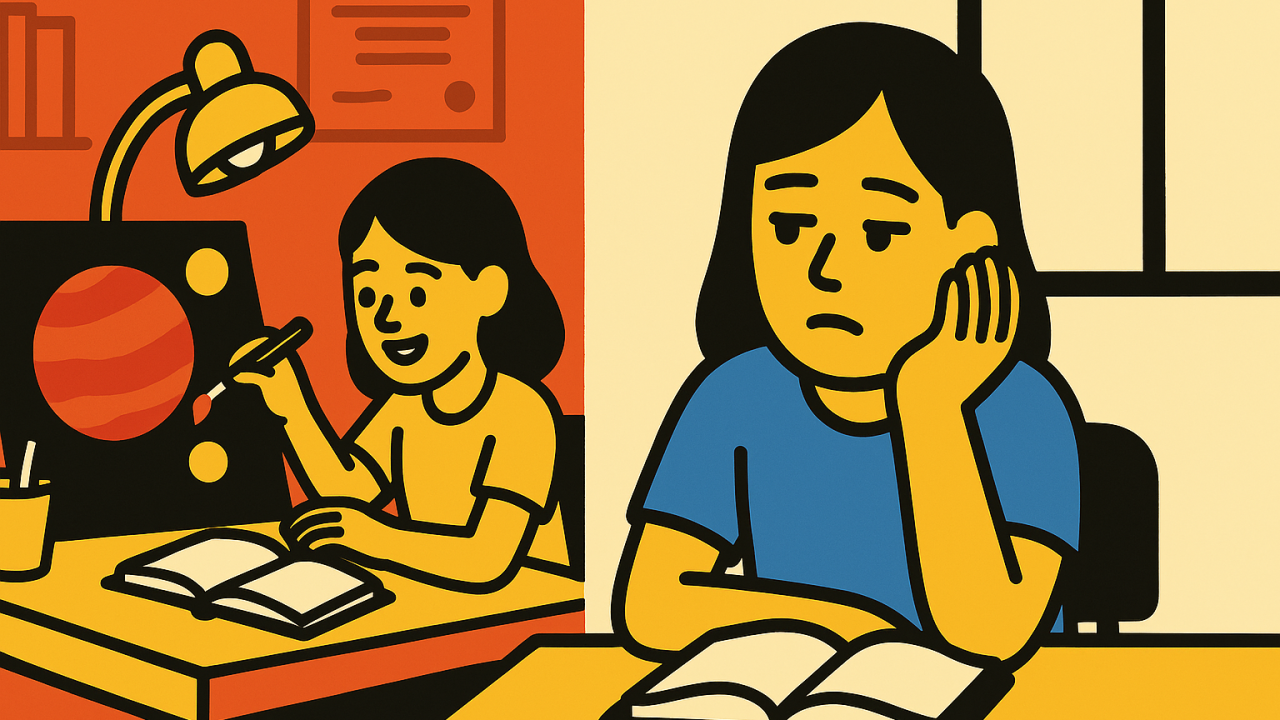
The Subject That’s Quietly Separating Ambitious Students from Their Goals
Every year, thousands of students who genuinely want careers in medicine, engineering, or technology hit the same unexpected wall. Not calculus. Not chemistry. Physics.
It’s the course that looks manageable from a distance and becomes something else entirely once you’re inside it. The formulas multiply, the concepts stop behaving intuitively, and the gap between what a student understands and what a test requires widens faster than most are prepared for.
And the frustrating part? Most of those students aren’t struggling because they lack ability. They’re struggling because physics is almost never taught the way it’s best learned.
Why Classrooms Keep Failing at This
The standard approach to physics education has a fundamental flaw built into it. Students are handed formulas and shown how to apply them — but rarely shown where they come from, or what they actually describe. A student who can solve a kinematics problem on Friday often cannot explain what velocity means on Monday. The knowledge is surface-level by design, because coverage matters more than comprehension in a classroom of thirty.
This produces a specific kind of student: one who can pass a test but collapses the moment a problem is framed differently. Universities see this constantly in first-year physics sequences. The student who memorized their way through high school hits material that demands genuine understanding — and suddenly there’s nothing to fall back on.
The solution isn’t more studying. It’s different studying. It’s someone slowing down long enough to ask where exactly the confusion starts, and working backward from there.
A Growing Recognition Among Families
Something has shifted in how parents approach this problem. The old model — wait for a bad grade, find a tutor, hope for the best — is giving way to something more deliberate. Families are treating academic support the way they treat sports coaching: not as a rescue operation, but as a consistent part of how a student develops.
This shift is most visible in cities where STEM industries have reshaped the local economy and, with it, the expectations placed on young people. Denver is one of those cities. Aerospace firms, biotech campuses, and a fast-growing tech sector have made scientific literacy feel less like an academic virtue and more like a basic requirement. In that environment, families seeking physics tutoring in Denver aren’t chasing grades — they’re thinking about what comes after graduation and working backward from there.
What Changes When a Student Gets Real Attention
One-on-one instruction does something that group settings structurally cannot. It finds the exact point where understanding breaks down and addresses it directly — not by repeating the same explanation, but with a different one. A good tutor doesn’t just reteach the lesson. They diagnose why the lesson didn’t work the first time.
For physics specifically, this often means going back further than expected. A student struggling with forces is frequently actually struggling with algebra. A student lost in electromagnetism often has a shaky grasp of ratios and proportionality that nobody caught in eighth grade. Fixing the surface problem without addressing the underlying one is temporary at best.
Students who get this kind of attention don’t just improve their grades. They change their relationship with the material — and with their own sense of what they’re capable of.
The Students Who Arrive Prepared
The students who thrive in demanding STEM programs aren’t always the ones who found physics easy. More often, they’re the ones who found it hard and figured out how to work through it anyway. Who asked enough questions, got enough support, and refused to accept early confusion as a permanent verdict on their abilities.
That kind of persistence doesn’t come from willpower alone. It comes from having the right environment at the right moment — someone who takes the difficulty seriously without making the student feel like the difficulty is their fault.
Conclusion
Physics doesn’t have to be the subject that closes doors. For most students who struggle with it, the problem was never ability — it was access. Access to the right explanation at the right moment, delivered by someone patient enough to find a different way in when the first one didn’t work.
The students who figure that out early carry something into every hard course that follows: the knowledge that confusion is temporary, and that understanding is always reachable. That’s not a small thing. In a world increasingly built on scientific and technical thinking, it might be the most valuable thing a student can learn.