
As regions throughout the country operate as usual for a regular Tuesday, the people of New Orleans and other cities along the Gulf Coast will prepare for the biggest celebration of our calendar year–Mardi Gras Day. Mardi Gras in New Orleans often holds an external perception of beads, Bourbon Street, and unruly, celebratory chaos. For Black New Orleanians, it is a sacred tradition rooted in resistance, with an instinctive routine and complex history.
The ongoing debates of the origins of Mardi Gras either place its start in Mobile, Alabama (when Mobile was initially the capital of Louisiana) with a Mardi Gras celebration held by French colonizers in 1703 or starting in New Orleans, Louisiana, when French colonizers arrived south of New Orleans in 1699, establishing and celebrating at the site named Pointe du Mardi Gras. Nonetheless, the Drake quote, “it’s not about who did it first, it’s ‘bout who did it right” said it best, and in this case, New Orleans’ role as the primary economic driver and popularizer of the holiday is inarguable.
Mardi Gras is French for ‘Fat Tuesday’ and closes out the Carnival season the day before Ash Wednesday, the first day of Lent in Catholicism. It serves as “the last hoorah” before 40 days of fasting, repentance, and abstinence until Easter Sunday. Carnival season begins on January 6, recognized as King’s Day. The season consists of purple, green, and gold, parades, marching bands, dance teams, krewes, Mardi Gras balls, beads, throws, and overindulgence (whether it be king cake, Popeyes, or libations). As a Catholic city with a large Black Catholic population and retained African traditions, the extent of our expression and the fullness of our spirituality are intrinsically linked.
Historically, racial exclusion and elitism have defined Mardi Gras. Black New Orleanians (both enslaved and free) were deemed not worthy of participation in the “secret societies” and masquerade balls of the white elites despite being revelers of the street Carnival festivities. The city enforced a law banning masks after concerns of Black people anonymously sneaking into white masquerade balls. The constant attempts of exclusion turned sour for segregationists in 1811, when nearly 500 enslaved people and maroons assembled, strategized, and rebelled under the leadership of Charles Deslondes along the German Coast of Louisiana (25 miles upriver from New Orleans). The group started their rebellion on January 8, just days into Carnival, while their enslavers were busy prepping for the season. Armed with weapons, they burned down plantations and executed enslavers who attempted to obstruct their goal of reaching New Orleans and establishing a free Black republic. Although they met their fate just outside of the city and suffered brutal and fatal consequences, their pursuit of freedom became the largest slave revolt in American history.
By the mid-1800s, white krewes maintained racial exclusion and incorporated white supremacist themes into their Carnival politics and power structures. Simultaneously, Black New Orleanians established their Carnival traditions and reasserted their claim to this celebration. While white parade revelers dressed in costumes, Black parade revelers practiced masking, a tradition rooted in African culture.
The North Side Skull & Bones Gang has been waking up the Tremé community on Mardi Gras morning since 1819. They drum throughout the streets of the nation’s oldest Black neighborhood, masked as skeletons in honor of the dead and as a caution to the living. “You next!” they chant as the symbolism of “skull and bone” embodies the literal meaning of Carnival, “the shedding of the flesh.”
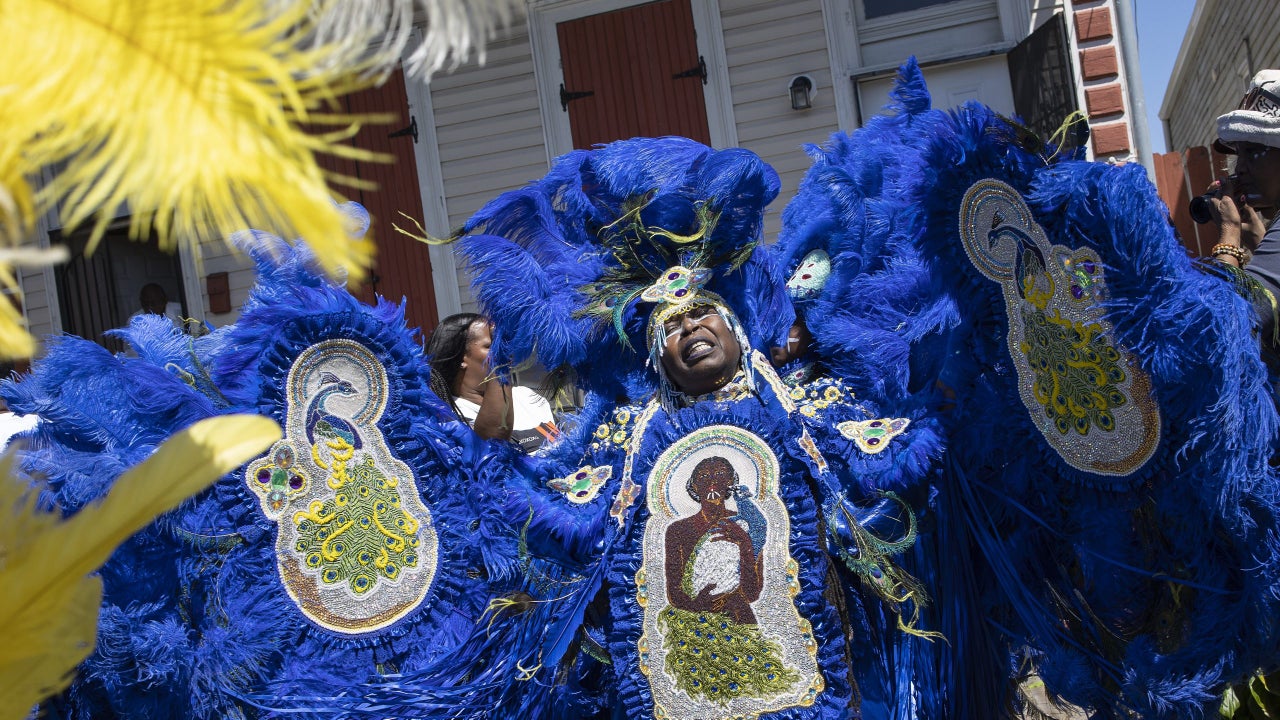
The most anticipated Mardi Gras tradition is the Black Masking Indians, often called the Mardi Gras Indians. Black Masking Indian history honors the relationships and bloodlines forged between Africans and Native Americans during slavery. Maroons were defined as Africans who escaped enslavement, often evading capture in the swamps surrounding plantations and establishing communities outside of the institution of slavery. Native peoples often met them with assistance, helping to provide the shelter and resourcefulness necessary for survival.
Today, this shared history lives through the Black Masking Indians’ genes and beaded suits, often showcasing revolutionary stories in intricate designs that are beaded by hand year-round to debut on Mardi Gras morning. They consist of tribes grouped by New Orleans’ Uptown, Downtown, and Westbank neighborhoods. Each tribe has a hierarchy with specific functions for each role–the Big Chief, Big Queen, Spy Boy, Flag Boy, and Wild Man. They meet up on Mardi Gras Day, invoking ancestral chants, prompting competitiveness over the “prettiest” suit, and reclaiming Black New Orleanians’ rightful place within Mardi Gras.
Black New Orleanians have created and preserved their own Carnival traditions for centuries despite attempts at exclusion throughout history. The Original Illinois Club was established as the first Black Mardi Gras organization in 1896. In 1901, Zulu–the all-Black krewe and Social Aid and Pleasure Club, formed as a marching club in protest and mockery of existing all-white krewes. As those all-white krewes rolled down the main streets of the parade routes, the real Mardi Gras was taking place in the backstreets of the surrounding Black neighborhoods. The Krewe of Zulu made history in 1969 when the city permitted them to roll down Canal Street’s main route on Mardi Gras Day, previously reserved for white krewes.
Carnival krewes in New Orleans did not desegregate until 1992 when a Black City Councilwoman named Dorothy Mae Taylor authored the ordinance to integrate Mardi Gras and challenged the elitist, racist practices embedded in Carnival. All white krewes–Comus, Momus, and Proteus–chose not to participate in Carnival altogether rather than desegregate their groups.
Marching bands are pivotal to Carnival season and add an element that only the home of jazz, second lines, and brass bands can. Local HBCUs like the renowned Southern University “Human Jukebox” Marching Band and local high schools, such as the esteemed St. Augustine High School Marching 100 Band, lead parades with rhythms that reverberate throughout the city and further solidify their reputation worldwide. Under the leadership of legendary band director, the late Edwin Harrell Hampton, the St. Augustine Marching 100 integrated Mardi Gras in 1967. They became the first Black band to march in a white parade–becoming a necessary representation in the Civil Rights Era and opening doors for various talented Black marching bands to fully participate in Carnival. “I can remember a very elderly, Black lady […] she got on her knees and thanked God, in a way that everybody could hear what she was saying, that she had lived to see this day when a Black band marched on Canal Street,” recalled Hampton in the 2000 Bended Knees documentary, directed by Kenny Chenier.
As the sun rises early on Mardi Gras morning, Black New Orleanians will already be in position as we enter into our annual routine–whether as revelers, band members, culture bearers, or krewe members. The central place where our traditions meet is where they always have, “under the bridge” at Orleans and Claiborne Avenues, where elders gathered in this once community space before ‘urban renewal’ policies constructed a highway through its thriving, Black business district. Black New Orleans continues to reclaim space in this sacred holiday despite ongoing displacement and historic exclusion. Many attempted to keep us unseen–and then we stole the show.